
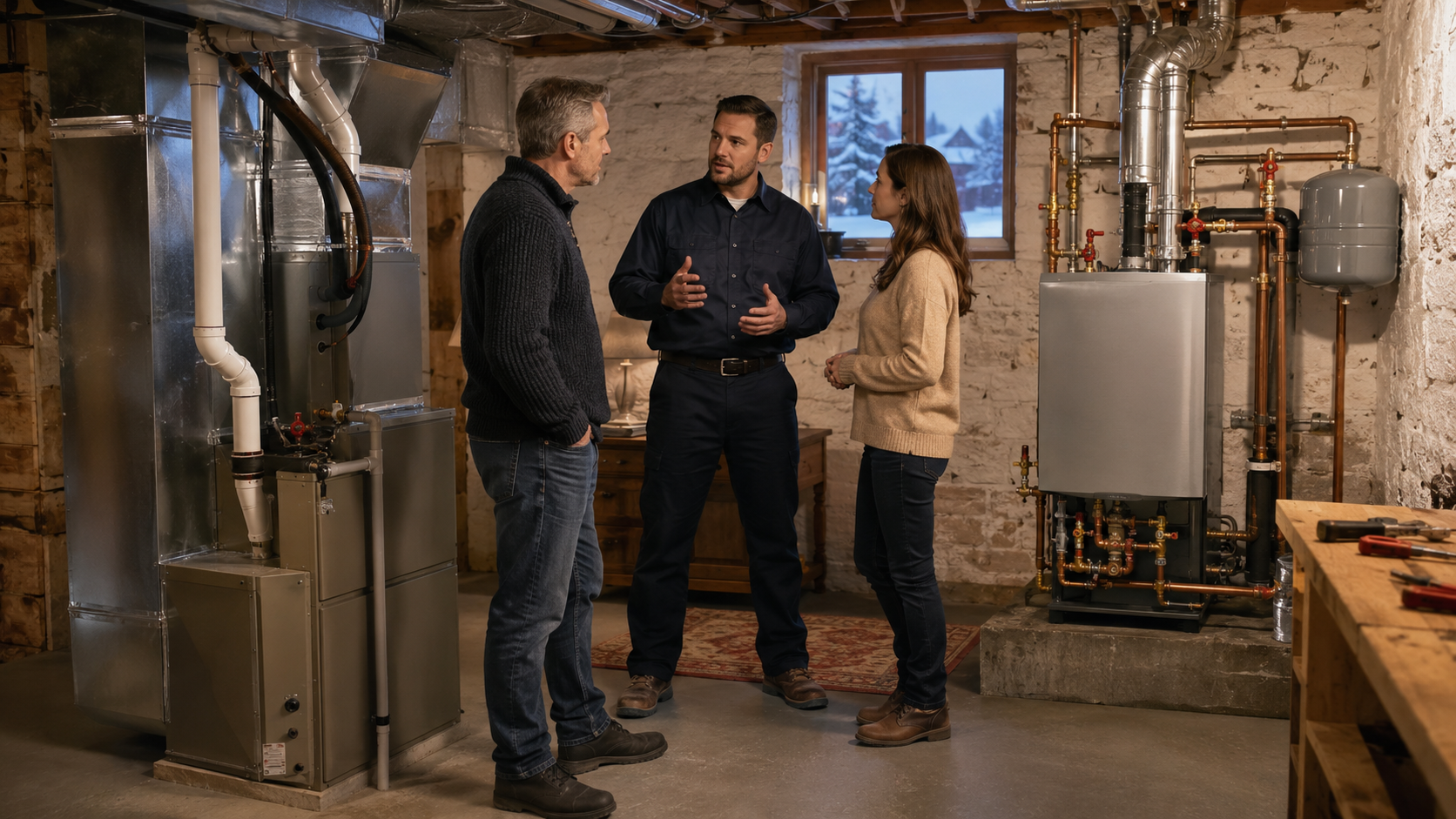
Furnaces and boilers can both heat Wisconsin homes reliably, but they do it through different distribution systems. A furnace moves heated air through ducts. A boiler circulates hot water through radiators, baseboard, or radiant loops. The best replacement path usually depends on what infrastructure the home already has.
Quick Answer
A furnace is often the practical fit for a home with usable ductwork and central air conditioning. A boiler is often the practical fit for a home with existing radiators or hydronic baseboard. Converting from one distribution type to the other can change the project far more than the equipment price alone.
Fast Decision Guide
Existing ductwork?
Compare furnace options and confirm airflow, duct condition, and central AC compatibility.
Existing radiators or baseboard?
Compare boiler repair or replacement before pricing a full distribution conversion.
Planning heating and cooling together?
Include furnace/AC, heat pump, and ductless options in the evaluation.
Why Homeowners Call 1st Choice Heating & Cooling
- Licensed and insured HVAC technicians
- Straightforward explanations before major repair or replacement decisions
- Residential heating, cooling, and indoor air quality expertise
- Serving Waukesha, Muskego, and nearby communities within the confirmed service area
- Financing options available for qualifying installations
How Furnaces and Boilers Heat a Home
A furnace heats air and distributes it through ductwork. A boiler heats water and sends it through radiators, baseboard units, or radiant systems. The two systems create comfort in different ways and rely on different infrastructure.
For an existing home, the most important question is often not which system wins in theory. It is which system fits the home’s current distribution network without an expensive conversion.
Furnace vs. Boiler Comparison
| Factor | Furnace | Boiler |
|---|---|---|
| Heat distribution | Forced air through ducts | Hot water through radiators, baseboard, or radiant loops |
| Cooling compatibility | Can share ducts with central AC | Does not provide ducted cooling by itself |
| Response | Often changes room temperature relatively quickly | Radiant or hydronic heat may feel steady but can respond more gradually |
| Air movement | Moves and filters air through the duct system | Uses little or no forced air for heating |
| Installation fit | Strongest when usable ductwork exists | Strongest when hydronic distribution already exists |
| Common maintenance focus | Filters, blower, burner, heat exchanger, controls | Burner, pumps, valves, pressure, expansion tank, piping, controls |
Which System Feels More Comfortable?
Comfort is subjective. Some homeowners prefer the steady surface warmth associated with radiators or radiant heat. Others value the quicker response, filtration, and shared cooling infrastructure of a forced-air system.
Uneven comfort can occur with either system. Furnaces depend on duct design and airflow balancing. Boilers depend on proper hydronic design, circulation, controls, and emitter sizing.
Which System Costs Less to Install?
Installation cost depends heavily on what the home already has. Replacing a furnace in a home with usable ducts is different from converting a boiler home to forced air. Likewise, replacing an existing boiler is different from adding new hydronic piping and emitters.
For replacement decisions, compare the installed scope—not only the equipment price. Include distribution changes, electrical work, venting, controls, cooling needs, permits when applicable, and restoration work.
Furnace and Boiler Efficiency
Both furnaces and boilers are available in a range of efficiency levels. The equipment rating matters, but so do sizing, installation, control strategy, distribution losses, maintenance, and the condition of the home.
Replacing equipment without addressing leaky ducts, poor hydronic balance, air leakage, or insulation may leave important comfort problems unresolved.
Which Heating System Fits the Home?
| Current condition or goal | Path worth evaluating |
|---|---|
| Home already has sound ductwork and central AC | Furnace replacement may preserve the existing distribution system |
| Home already has radiators or hydronic baseboard | Boiler replacement may avoid a major distribution conversion |
| Home needs new cooling as well as heat | Compare furnace/AC, heat pump, and other integrated options |
| Home has additions or difficult rooms | Evaluate zoning, duct modifications, hydronic changes, or supplemental mini splits |
| Homeowner wants to switch distribution types | Price the full conversion, not only the heating appliance |
Questions to Ask Before Choosing
- What distribution system already exists?
- Is that ductwork or hydronic piping in good condition?
- Does the home need central cooling?
- Are comfort problems caused by equipment or distribution?
- What fuel and venting options are available?
- How much disruption will installation require?
- What maintenance does each option require?
- How will the system perform during Wisconsin design temperatures?
Do Not Ignore Heat Pumps and Hybrid Options
The decision is not always limited to a furnace or boiler. Some homes may also be candidates for a heat pump, ductless mini split, or dual-fuel approach. The right comparison depends on the home, electrical service, distribution, comfort goals, and backup-heat plan.
Review heat pump services and ductless mini split options when evaluating a broader heating and cooling upgrade.
Frequently Asked Questions
Is a boiler better than a furnace?
Neither is universally better. The practical choice depends on existing distribution, cooling needs, comfort preferences, installation scope, and budget.
Is boiler heat more comfortable?
Some homeowners prefer the steady feel of radiant or hydronic heat. Others prefer the response, filtration, and cooling compatibility of forced air.
Can I replace a boiler with a furnace?
Yes in some homes, but the project may require new ductwork, venting, electrical work, and restoration. Price the full conversion before deciding.
Can a boiler provide air conditioning?
A boiler does not provide ducted cooling by itself. Cooling requires a separate system such as central AC with ducts or ductless mini splits.
Which lasts longer, a furnace or a boiler?
Service life varies by equipment type, installation, maintenance, water or air quality, usage, and operating conditions. Condition is more useful than age alone.
Should I consider a heat pump instead?
Possibly. Heat pumps can provide heating and cooling, but equipment capacity, electrical requirements, distribution, backup heat, and cold-weather performance must be evaluated.
Compare Heating Replacement Options
1st Choice can evaluate the home’s existing furnace, boiler, ducts, radiators, cooling needs, and upgrade goals before recommending a responsible path.
