Furnace Tune-Up Cost in Wisconsin: What’s Included?

A furnace tune-up cost only makes sense when you know what the service includes. This guide explains furnace tune-up pricing in Wisconsin, what technicians typically inspect, which findings may lead to separate repair recommendations, and how to decide whether preventive heating maintenance is worth scheduling.

How Much Does a Furnace Tune-Up Cost?

Furnace tune-up prices vary based on the contractor, furnace type, maintenance scope, membership status, and seasonal promotions. At the time of publication, 1st Choice Heating & Cooling’s current furnace tune-up offer is $189.95, with approved membership incentives. Offers and terms can change, so homeowners should confirm the current coupons and promotions before scheduling.

The more useful comparison is not simply the lowest advertised price. Compare what the visit includes, how thoroughly the furnace is evaluated, whether findings are documented, and whether repairs or replacement parts are quoted separately.

Fast Furnace Tune-Up Cost Guide

Need routine maintenance?

A furnace that is operating normally but has not been serviced recently is generally a good candidate for a preventive tune-up.

Furnace already malfunctioning?

No heat, repeated shutdowns, short cycling, unusual noises, or another active failure may require furnace repair rather than routine maintenance.

Considering replacement?

If an older furnace needs frequent repairs or a major component has failed, compare the repair with heating replacement options before investing heavily in the existing equipment.

Why Homeowners Call 1st Choice Heating & Cooling

  • Licensed and insured HVAC technicians
  • Clear explanations before additional repair work is approved
  • Heating maintenance, furnace repair, replacement, and indoor comfort expertise
  • Serving Waukesha, Muskego, and nearby communities within the confirmed service area
  • Current maintenance offers available through the 1st Choice coupons page

What Affects Furnace Tune-Up Cost?

Furnace maintenance prices can look very different even when two companies use the same phrase, “furnace tune-up.” The difference may come from the scope of service rather than the equipment alone.

Cost factor Why it matters What to ask
Inspection depth A short visual inspection is different from a more detailed evaluation of operation, safety controls, airflow, ignition, and accessible components. Can I review the maintenance checklist before scheduling?
Furnace type Gas, electric, oil, and other heating systems can involve different maintenance procedures and components. Does this tune-up price apply to my furnace type?
System condition Equipment with heavy buildup, abnormal operation, or a failed component may need work beyond routine maintenance. Will additional work be quoted separately?
Membership status Some maintenance plans include discounted visits, recurring service, or additional benefits. What is the member price, nonmember price, and plan term?
Seasonal promotion HVAC companies may offer different pricing before or during heating season. Is this the current offer, and are there restrictions?
Number of systems Homes with multiple furnaces or separate heating systems may require more than one maintenance visit or service scope. Is the advertised price per system?

What Is Included in a Furnace Tune-Up?

The exact checklist depends on the furnace and contractor, but a professional maintenance appointment should give you useful information about how the heating system is operating before Wisconsin’s coldest weather arrives.

A furnace tune-up may include evaluating:

  • Thermostat operation and heating calls
  • Furnace startup and shutdown behavior
  • Filter condition and airflow
  • Accessible electrical connections and controls
  • Ignition and burner operation on applicable systems
  • Safety controls and switches
  • Blower operation and visible component condition
  • Venting and combustion-related components where applicable
  • Signs of unusual wear, leakage, overheating, or deterioration
  • Overall heating performance and technician recommendations

A maintenance visit is not the same as replacing every worn component. If testing identifies a failed part or another condition requiring corrective work, the technician should explain the finding and provide a separate recommendation.

For the broader service itself, visit heating maintenance services.

What Usually Costs Extra?

A furnace tune-up covers a defined maintenance scope. Depending on the contractor and equipment, additional work may be priced separately.

Common examples include:

  • Replacement parts
  • Corrective furnace repairs
  • Major component replacement
  • Repairs to thermostats or controls
  • Extensive cleaning outside the maintenance scope
  • Duct repairs or modifications
  • Heating system replacement

The important part is transparency. If the tune-up uncovers another problem, you should understand what was found, why it matters, how urgent it is, and what the additional work will cost before approving it.

Furnace Tune-Up vs. Furnace Repair

Factor Furnace Tune-Up Furnace Repair
Primary purpose Preventive evaluation and routine maintenance Diagnose and correct an existing malfunction
Typical timing Before or during heating season while the furnace is generally operating When the furnace is not working normally
Common reason to schedule Annual maintenance, system check, seasonal preparation No heat, short cycling, abnormal noises, shutdowns, weak heating, or another active problem
Parts included? Usually not unless specifically stated in the maintenance scope Replacement parts and labor depend on the diagnosed repair
Best next step Heating maintenance Furnace repair

Is a Furnace Tune-Up Worth the Cost?

For many Wisconsin homeowners, yes—especially when the furnace has not been evaluated recently or is about to enter another season of heavy use.

The value of maintenance is not that it guarantees a breakdown will never occur. No tune-up can guarantee the future life of every motor, control, sensor, or other component. The value is the opportunity to evaluate the system before a failure, identify certain developing concerns, and understand the condition of the equipment.

A tune-up may be particularly useful when:

  • The furnace has not received professional maintenance recently
  • You recently purchased the home and do not know the service history
  • The furnace is older but still operating reliably
  • Heating performance has changed gradually
  • You want the system evaluated before sustained freezing weather
  • You want a clearer picture of repair or replacement needs before an emergency occurs

If the furnace is already failing, skip the preventive-service mindset and schedule furnace repair instead.

When Should You Schedule a Furnace Tune-Up in Wisconsin?

Many homeowners prefer to schedule heating maintenance before sustained cold weather begins. That allows time to evaluate the furnace before it is operating for long periods every day.

However, missing the early-fall window does not mean maintenance is no longer useful. If the furnace is operating normally but has gone through part of the winter without recent service, a maintenance visit can still provide useful information about system condition.

The practical timing is:

  • Before heating season: ideal for preparing the furnace before heavy use
  • During heating season: still useful when routine maintenance was missed earlier
  • After purchasing a home: helpful when the previous maintenance history is unknown
  • After major service: future maintenance can provide a new baseline for system condition

What Happens If the Tune-Up Finds a Problem?

Finding a problem does not mean every recommendation is automatically an emergency.

A useful maintenance visit should help separate findings into practical categories:

  • Needs attention now: a condition affecting normal operation or requiring timely corrective service
  • Monitor: wear or deterioration that is not currently preventing normal operation but should be watched
  • Optional improvement: an upgrade that may improve comfort, controls, filtration, or another homeowner priority
  • Replacement discussion: a larger issue that changes the economics of continuing to repair an older system

If corrective work is needed, review our furnace repair services. If the system has reached the point where repeated repairs no longer make sense, compare heating installation and replacement options before making the next investment.

What Can Homeowners Do Between Furnace Tune-Ups?

Professional maintenance involves system evaluation that goes beyond basic homeowner care, but a few simple habits can support normal operation between appointments.

  • Inspect the furnace filter regularly and replace it when needed
  • Keep supply registers and return-air openings clear
  • Pay attention to new noises, odors, cycling patterns, or changes in heating performance
  • Avoid storing combustible materials against heating equipment
  • Know where the furnace power switch and appropriate electrical breaker are located
  • Keep carbon monoxide alarms installed and maintained according to their manufacturer instructions

If dust, filtration, dry winter air, humidity, or other whole-home comfort concerns are part of the problem, explore indoor air quality services rather than expecting a furnace tune-up to solve every IAQ issue.

Which Heating Service Do You Need?

Furnace is working

Schedule heating maintenance when the goal is preventive inspection and seasonal care.

Furnace has a problem

Choose furnace repair for no heat, short cycling, unusual noises, shutdowns, or another active malfunction.

Repairs keep adding up

Compare heating replacement when reliability and repair costs are changing the value of keeping the existing system.

Frequently Asked Questions About Furnace Tune-Ups

How much does a furnace tune-up cost in Wisconsin?

Furnace tune-up pricing varies by contractor, furnace type, service scope, membership status, and available promotions. At the time of publication, 1st Choice Heating & Cooling’s current furnace tune-up offer is $189.95, with approved membership incentives. Because offers can change, verify the current price and terms on the coupons page.

What is included in a furnace tune-up?

The exact checklist varies, but furnace maintenance commonly involves evaluating thermostat operation, heating cycles, airflow, filters, accessible electrical components, ignition and burner operation where applicable, safety controls, venting, and the overall condition of the system.

Is a furnace tune-up the same as a repair?

No. A tune-up is preventive maintenance performed when the furnace is generally operating. Repair is corrective service used to diagnose and fix an existing malfunction.

How often should a furnace be tuned up?

Many homeowners schedule furnace maintenance annually, often before sustained heating demand begins. The appropriate maintenance schedule can also depend on the equipment, manufacturer guidance, usage, and service history.

How long does a furnace tune-up take?

The time required depends on the furnace, its condition, accessibility, and the contractor’s maintenance checklist. A more detailed evaluation generally takes longer than a basic visual inspection.

Can a furnace tune-up prevent every breakdown?

No. Maintenance can help identify certain developing problems and support reliable operation, but it cannot guarantee that every furnace component will continue working.

Can I tune up my furnace myself?

Homeowners can handle basic tasks such as checking filters and keeping registers clear. Internal electrical, combustion, safety-control, and mechanical evaluation should be left to qualified HVAC professionals.

Should I tune up an older furnace?

Age alone does not make maintenance pointless. A tune-up can provide useful information about an older furnace’s condition. If significant repairs are already anticipated, however, it may make sense to compare the cost of continued service with replacement.

What happens if the technician finds a bad part?

A failed component or corrective repair is generally separate from routine maintenance unless the service agreement specifically states otherwise. The technician should explain the finding and obtain approval before additional work is performed.

Should I schedule maintenance if my furnace is already short cycling?

Short cycling is an active operating problem rather than routine maintenance alone. If the furnace repeatedly starts and stops without completing normal heating cycles, schedule a diagnostic furnace repair visit.

Check the Current Furnace Tune-Up Offer

Schedule preventive heating maintenance before the next stretch of Wisconsin cold weather. 1st Choice Heating & Cooling can evaluate your furnace, explain the findings, and separate routine maintenance from any additional repair recommendations.
Furnace vs. Boiler: Which Is Better for a Wisconsin Home?

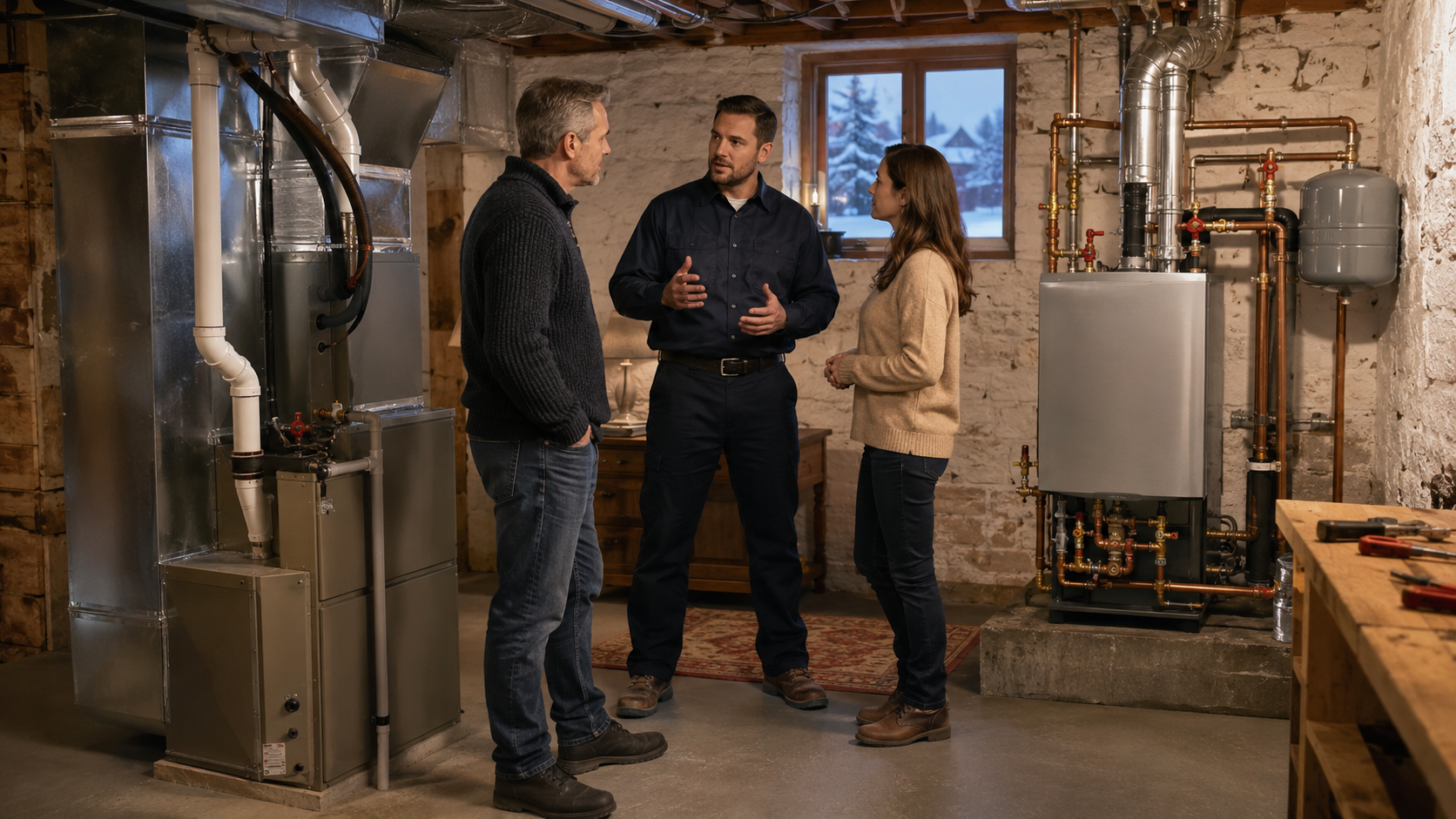
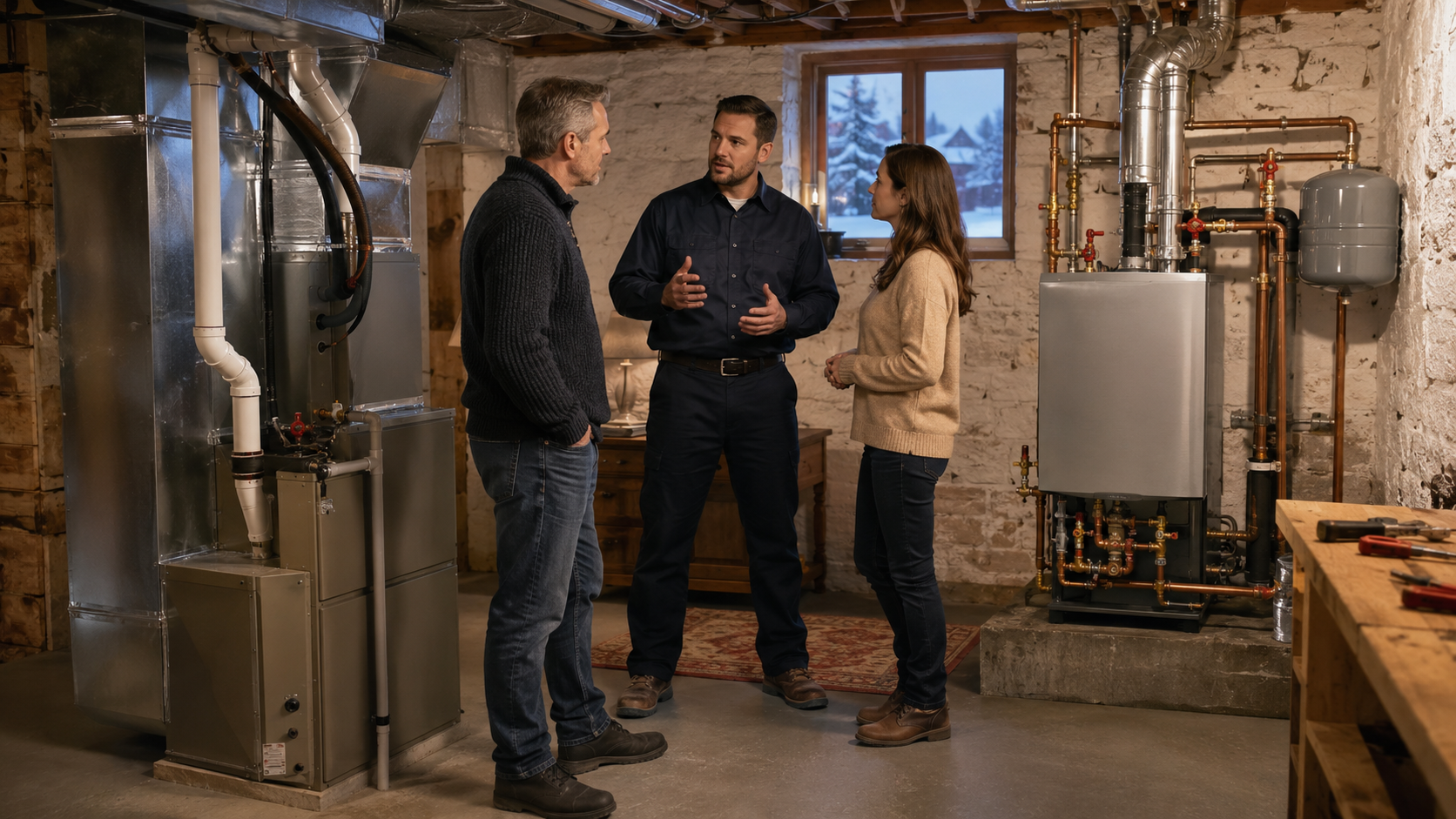
Wisconsin homeowners compare a forced-air furnace and hydronic boiler with a heating specialist

Furnaces and boilers can both heat Wisconsin homes reliably, but they do it through different distribution systems. A furnace moves heated air through ducts. A boiler circulates hot water through radiators, baseboard, or radiant loops. The best replacement path usually depends on what infrastructure the home already has.

Quick Answer

A furnace is often the practical fit for a home with usable ductwork and central air conditioning. A boiler is often the practical fit for a home with existing radiators or hydronic baseboard. Converting from one distribution type to the other can change the project far more than the equipment price alone.

Fast Decision Guide

Existing ductwork?

Compare furnace options and confirm airflow, duct condition, and central AC compatibility.

Existing radiators or baseboard?

Compare boiler repair or replacement before pricing a full distribution conversion.

Planning heating and cooling together?

Include furnace/AC, heat pump, and ductless options in the evaluation.

Why Homeowners Call 1st Choice Heating & Cooling

  • Licensed and insured HVAC technicians
  • Straightforward explanations before major repair or replacement decisions
  • Residential heating, cooling, and indoor air quality expertise
  • Serving Waukesha, Muskego, and nearby communities within the confirmed service area
  • Financing options available for qualifying installations

How Furnaces and Boilers Heat a Home

A furnace heats air and distributes it through ductwork. A boiler heats water and sends it through radiators, baseboard units, or radiant systems. The two systems create comfort in different ways and rely on different infrastructure.

For an existing home, the most important question is often not which system wins in theory. It is which system fits the home’s current distribution network without an expensive conversion.

Furnace vs. Boiler Comparison

Factor Furnace Boiler
Heat distribution Forced air through ducts Hot water through radiators, baseboard, or radiant loops
Cooling compatibility Can share ducts with central AC Does not provide ducted cooling by itself
Response Often changes room temperature relatively quickly Radiant or hydronic heat may feel steady but can respond more gradually
Air movement Moves and filters air through the duct system Uses little or no forced air for heating
Installation fit Strongest when usable ductwork exists Strongest when hydronic distribution already exists
Common maintenance focus Filters, blower, burner, heat exchanger, controls Burner, pumps, valves, pressure, expansion tank, piping, controls

Which System Feels More Comfortable?

Comfort is subjective. Some homeowners prefer the steady surface warmth associated with radiators or radiant heat. Others value the quicker response, filtration, and shared cooling infrastructure of a forced-air system.

Uneven comfort can occur with either system. Furnaces depend on duct design and airflow balancing. Boilers depend on proper hydronic design, circulation, controls, and emitter sizing.

Which System Costs Less to Install?

Installation cost depends heavily on what the home already has. Replacing a furnace in a home with usable ducts is different from converting a boiler home to forced air. Likewise, replacing an existing boiler is different from adding new hydronic piping and emitters.

For replacement decisions, compare the installed scope—not only the equipment price. Include distribution changes, electrical work, venting, controls, cooling needs, permits when applicable, and restoration work.

Furnace and Boiler Efficiency

Both furnaces and boilers are available in a range of efficiency levels. The equipment rating matters, but so do sizing, installation, control strategy, distribution losses, maintenance, and the condition of the home.

Replacing equipment without addressing leaky ducts, poor hydronic balance, air leakage, or insulation may leave important comfort problems unresolved.

Which Heating System Fits the Home?

Current condition or goal Path worth evaluating
Home already has sound ductwork and central AC Furnace replacement may preserve the existing distribution system
Home already has radiators or hydronic baseboard Boiler replacement may avoid a major distribution conversion
Home needs new cooling as well as heat Compare furnace/AC, heat pump, and other integrated options
Home has additions or difficult rooms Evaluate zoning, duct modifications, hydronic changes, or supplemental mini splits
Homeowner wants to switch distribution types Price the full conversion, not only the heating appliance

Questions to Ask Before Choosing

  • What distribution system already exists?
  • Is that ductwork or hydronic piping in good condition?
  • Does the home need central cooling?
  • Are comfort problems caused by equipment or distribution?
  • What fuel and venting options are available?
  • How much disruption will installation require?
  • What maintenance does each option require?
  • How will the system perform during Wisconsin design temperatures?

Do Not Ignore Heat Pumps and Hybrid Options

The decision is not always limited to a furnace or boiler. Some homes may also be candidates for a heat pump, ductless mini split, or dual-fuel approach. The right comparison depends on the home, electrical service, distribution, comfort goals, and backup-heat plan.

Review heat pump services and ductless mini split options when evaluating a broader heating and cooling upgrade.

Frequently Asked Questions

Is a boiler better than a furnace?

Neither is universally better. The practical choice depends on existing distribution, cooling needs, comfort preferences, installation scope, and budget.

Is boiler heat more comfortable?

Some homeowners prefer the steady feel of radiant or hydronic heat. Others prefer the response, filtration, and cooling compatibility of forced air.

Can I replace a boiler with a furnace?

Yes in some homes, but the project may require new ductwork, venting, electrical work, and restoration. Price the full conversion before deciding.

Can a boiler provide air conditioning?

A boiler does not provide ducted cooling by itself. Cooling requires a separate system such as central AC with ducts or ductless mini splits.

Which lasts longer, a furnace or a boiler?

Service life varies by equipment type, installation, maintenance, water or air quality, usage, and operating conditions. Condition is more useful than age alone.

Should I consider a heat pump instead?

Possibly. Heat pumps can provide heating and cooling, but equipment capacity, electrical requirements, distribution, backup heat, and cold-weather performance must be evaluated.

Compare Heating Replacement Options

1st Choice can evaluate the home’s existing furnace, boiler, ducts, radiators, cooling needs, and upgrade goals before recommending a responsible path.

Whole-House Humidifier Cost: Installation, Maintenance, and Best Fit

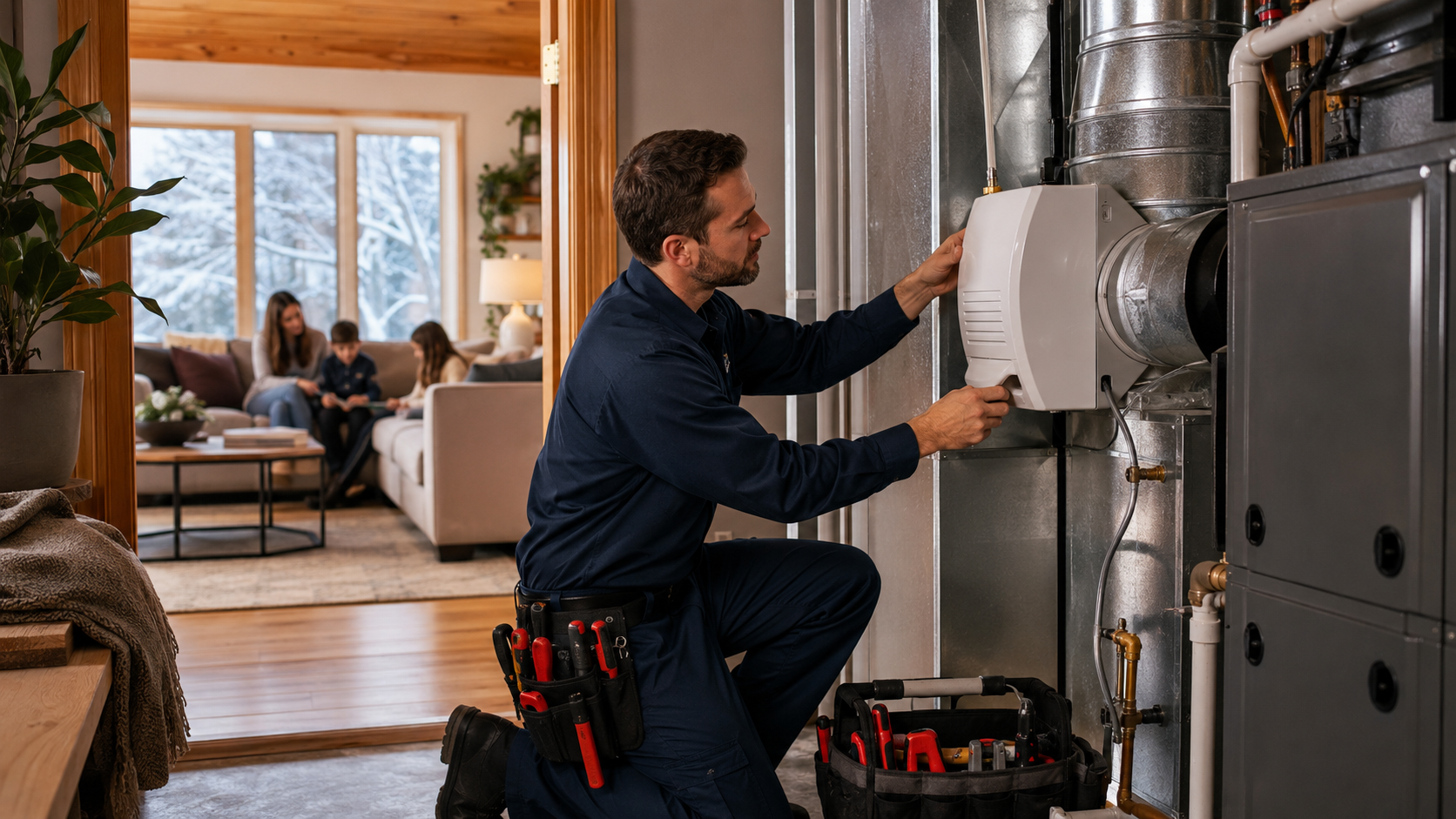
Technician installs a whole-house humidifier to improve winter comfort in a Wisconsin home

A whole-house humidifier can provide centralized winter humidity control without carrying portable units from room to room. Installation cost varies by humidifier type, capacity, duct configuration, water and drain access, controls, and the amount of labor required.

Quick Answer

Whole-house humidifier pricing depends on whether the home needs a bypass, fan-powered, or steam unit; how the equipment connects to the duct system; and what water, drain, electrical, and control work is required. The estimate should include equipment, installation scope, controls, maintenance expectations, and warranty.

Fast Decision Guide

Tired of portable units?

Compare a centrally controlled whole-house system.

Seeing window condensation?

Do not add more humidity until settings and home conditions are evaluated.

Replacing a leaking old unit?

Compare repair cost, cabinet condition, control compatibility, and replacement capacity.

Why Homeowners Call 1st Choice Heating & Cooling

  • Licensed and insured HVAC technicians
  • Straightforward explanations before major repair or replacement decisions
  • Residential heating, cooling, and indoor air quality expertise
  • Serving Waukesha, Muskego, and nearby communities within the confirmed service area
  • Financing options available for qualifying installations

What Determines Whole-House Humidifier Cost?

A whole-house humidifier is installed into or alongside a compatible heating and air-distribution system. Cost depends on humidifier type, home size, furnace and duct configuration, water access, drainage, electrical or control needs, and whether installation requires modifications.

Because those conditions vary, an in-home evaluation is more useful than a national average that may not match the home or the proposed equipment.

Common Whole-House Humidifier Types

Type How it works Planning consideration
Bypass Uses the HVAC system’s airflow and a bypass duct Needs appropriate duct space and generally operates with the blower
Fan-powered Uses an internal fan to move air across the water panel May deliver greater output without a bypass duct but needs power
Steam Generates steam and distributes it through the duct system Offers precise output potential with higher equipment and electrical requirements

Whole-House Humidifier Installation Cost Factors

  • Humidifier type and capacity
  • Home size and target humidity needs
  • Supply and return duct configuration
  • Available mounting space
  • Nearby water supply
  • Drain location and routing
  • Electrical requirements
  • Humidistat or smart-control integration
  • Condition of the furnace and duct system
  • Labor needed to modify sheet metal or controls

Who May Benefit From a Whole-House Humidifier?

A whole-house system may be worth evaluating when winter air feels persistently dry across much of the home, portable units require constant refilling, wood finishes react to seasonal dryness, static electricity is frequent, or the homeowner wants centralized humidity control.

A humidifier should not be used to mask moisture loss caused by excessive air leakage. It also must be controlled correctly; too much winter humidity can create window condensation or moisture problems.

What Maintenance Does a Whole-House Humidifier Need?

Task Why it matters
Replace or clean the water panel as required Mineral buildup can reduce output and airflow
Inspect water lines and valves Helps identify leaks or restricted flow
Clean the drain and distribution tray Reduces buildup and drainage problems
Check humidistat operation Maintains appropriate control
Adjust seasonal settings Outdoor temperature affects how much indoor humidity a home can hold safely
Inspect during heating maintenance Coordinates humidifier and furnace operation

What Indoor Humidity Setting Is Best in Winter?

The appropriate setting changes with outdoor temperature, window performance, insulation, and the home’s construction. If condensation appears on windows or cold surfaces, the setting may be too high for current conditions.

A professional can explain how to adjust the control as weather changes. Avoid treating one percentage as correct for every home and every winter day.

Repair or Replace an Existing Humidifier?

  • Repair may make sense for an isolated valve, control, drain, or water-panel problem
  • Replacement may be worth comparing when the cabinet is corroded, leaks recur, parts are unavailable, or capacity no longer fits the home
  • A system that creates excessive moisture may have a control, sizing, or installation problem—not simply a failed humidifier

What a Humidifier Estimate Should Include

  • Recommended humidifier type and capacity
  • Installation location
  • Water and drain scope
  • Electrical and control requirements
  • Furnace and thermostat compatibility
  • Maintenance requirements
  • Equipment and labor warranty
  • Final testing and homeowner instruction

Frequently Asked Questions

How much does a whole-house humidifier cost?

Cost depends on type, capacity, ductwork, water and drain access, controls, electrical needs, and installation labor. An in-home evaluation is needed for an accurate price.

Is a whole-house humidifier worth it?

It may be worthwhile when dry air affects much of the home and the homeowner wants centralized control. The system still requires correct settings and routine maintenance.

Can a humidifier be added to an existing furnace?

Often yes, if there is compatible duct space, control capacity, water access, drainage, and an appropriate installation location.

Can a whole-house humidifier cause mold?

Excessive humidity can contribute to condensation and moisture problems. Correct sizing, controls, maintenance, and seasonal adjustment reduce that risk.

How often does a whole-house humidifier need maintenance?

Maintenance frequency depends on the model, water quality, usage, and manufacturer guidance. Water panels and drainage components commonly need periodic service.

Get a Whole-House Humidifier Estimate

1st Choice can evaluate the heating system, ductwork, water and drain access, and humidity concerns before recommending an appropriate solution.

How Many Mini Splits Does Your Home Need?

HVAC specialist plans the right number of mini-split zones for a comfortable multi-room home

The number of mini splits a home needs depends on zones, not a universal rooms-to-units formula. An open floor plan may work with one properly sized indoor unit, while bedrooms with closed doors may need separate zones. A room-by-room load calculation is the responsible way to plan the system.

Quick Answer

There is no fixed number of mini splits per home. Count the areas that need independent comfort, then evaluate each zone’s heating and cooling load, layout, door use, insulation, windows, and air movement. One indoor unit can sometimes serve an open connected area, but it usually cannot condition several closed rooms reliably.

Fast Decision Guide

One problem room?

A single-zone mini split may be the simplest solution.

Several closed bedrooms?

Plan separate loads and zones rather than assuming one hallway unit will work.

Whole home without ducts?

Compare multiple single-zone systems with a multi-zone design and other HVAC options.

Why Homeowners Call 1st Choice Heating & Cooling

  • Licensed and insured HVAC technicians
  • Straightforward explanations before major repair or replacement decisions
  • Residential heating, cooling, and indoor air quality expertise
  • Serving Waukesha, Muskego, and nearby communities within the confirmed service area
  • Financing options available for qualifying installations

A Mini Split Is Sized by Zones, Not Just Room Count

A common shortcut is to assume every room needs its own indoor unit. That is not always true. A zone may be one room, several connected spaces, or one floor, depending on layout, doorways, load, comfort expectations, and how air can move.

The system must also account for heating and cooling loads. Square footage is only one input. Insulation, windows, ceiling height, orientation, occupancy, equipment, and Wisconsin design temperatures all influence capacity.

Room-by-Room Mini Split Planning

Space Common planning question Why it matters
Open living, dining, and kitchen area Can one head serve the connected space? Open sightlines may allow one zone when capacity and air distribution work
Bedrooms Will doors stay closed overnight? Closed doors limit air movement between rooms
Finished basement Is moisture or temperature different from upstairs? Below-grade spaces often have a separate load profile
Home addition Can the existing central system reach it? A dedicated zone may avoid extending inadequate ductwork
Garage or workshop Is the space insulated and used year-round? Envelope and usage can materially change required capacity
Second floor Are there multiple closed rooms or one open area? Room layout determines whether one or several zones are practical

What Determines Mini Split Capacity?

  • Square footage and ceiling height
  • Insulation and air leakage
  • Window size, orientation, and sun exposure
  • Exterior walls and roof exposure
  • Number of occupants
  • Heat-producing appliances and electronics
  • Whether the system will heat, cool, or do both
  • How often doors between spaces remain open
  • Existing heating or cooling equipment

Single-Zone vs. Multi-Zone Mini Splits

A single-zone system connects one outdoor unit to one indoor unit. A multi-zone system connects one outdoor unit to multiple indoor units. Multi-zone equipment can reduce the number of outdoor units, but each indoor zone still requires appropriate capacity, line routing, condensate management, and controls.

One large indoor head is not a substitute for proper distribution. If bedrooms remain closed, the hallway temperature does not prove that each room will be comfortable.

Example Planning Scenarios

Home need Possible starting configuration What must be verified
One hot upstairs bedroom One dedicated single-zone unit Room load, outdoor-unit location, line route
Open first floor One well-positioned zone may be possible Total load and air distribution
Three closed bedrooms Multiple zones or another system approach Individual room loads and multi-zone capacity
Addition plus existing central HVAC Dedicated zone for the addition Whether the central system should remain unchanged
Older home without ducts Several planned zones Whole-home load, room separation, electrical and mounting locations

Mini Split Sizing Mistakes to Avoid

  • Choosing capacity from square footage alone
  • Using one indoor unit for several closed rooms without an airflow plan
  • Oversizing “to be safe”
  • Ignoring winter heating performance
  • Selecting indoor-unit locations based only on appearance
  • Forgetting condensate drainage and service access
  • Assuming every outdoor unit can support every combination of indoor heads

What Happens During a Mini Split Evaluation?

A useful evaluation maps the comfort problem, calculates room or zone loads, reviews electrical capacity, identifies outdoor and indoor unit locations, plans refrigerant lines and drains, and compares single-zone with multi-zone configurations.

For service details and current installation options, visit ductless mini split installation in Waukesha and Muskego.

Frequently Asked Questions

Does every room need a mini split?

No. Open connected spaces may share a zone, while rooms that are normally closed often need separate planning.

Can one mini split cool an entire house?

It can in some small, open homes, but many houses need multiple zones because walls, floors, and closed doors limit air distribution.

How many rooms can one mini split cool?

Room count alone is not a reliable measure. Layout, load, door position, unit placement, and capacity determine the usable zone.

Is it better to use several single-zone systems or one multi-zone system?

Both can work. The choice affects redundancy, outdoor-unit count, efficiency, line routing, capacity, and cost.

Can mini splits heat during a Wisconsin winter?

Many cold-climate systems can provide heating, but equipment selection and low-temperature capacity must be evaluated for the home and design conditions.

Plan the Right Mini Split Zones

1st Choice can evaluate each room, plan practical zones, and compare single-zone and multi-zone configurations for the home.

Should You Replace Your Furnace and AC at the Same Time?

Homeowner compares replacing a furnace and air conditioner together during a coordinated HVAC installation

When one half of a home’s heating and cooling system fails, homeowners often wonder whether replacing the furnace and air conditioner together is smarter than replacing only the failed equipment. The answer depends on age, compatibility, condition, efficiency goals, budget, and the likelihood of paying for another installation soon.

Quick Answer

Replacing the furnace and AC together can make sense when both systems are aging, equipment compatibility limits the available options, or one combined installation avoids repeating labor and disruption. Replacing only the failed system may be better when the other system is newer, compatible, and performing reliably.

Fast Decision Guide

Systems close in age?

Price both a single-system and combined replacement before deciding.

One system still fairly new?

Confirm equipment compatibility and expected remaining life before replacing it early.

Budget is the constraint?

Compare the cost of phasing with the risk of a second breakdown and installation.

Why Homeowners Call 1st Choice Heating & Cooling

  • Licensed and insured HVAC technicians
  • Straightforward explanations before major repair or replacement decisions
  • Residential heating, cooling, and indoor air quality expertise
  • Serving Waukesha, Muskego, and nearby communities within the confirmed service area
  • Financing options available for qualifying installations

When Replacing the Furnace and AC Together Can Make Sense

A furnace and central air conditioner often share the indoor blower, duct system, thermostat, and part of the installation workspace. Replacing both together can simplify compatibility decisions and reduce repeated disruption, but it also increases the immediate project scope.

The correct decision depends on the age and condition of each system. A failed AC does not automatically make a newer furnace obsolete, and a failed furnace does not always require AC replacement.

Replace One System or Both?

Situation Replace one may make sense Replacing both deserves consideration
One system is relatively new The newer equipment is compatible and performing well Compatibility or refrigerant requirements create limitations
Both systems are near the end of expected service life Budget requires phasing and the remaining system is reliable Avoiding a second installation and breakdown is a priority
Major efficiency upgrade The retained system supports the planned equipment Matched equipment or controls are needed for the desired performance
Home comfort problems The problem is isolated to one piece of equipment Airflow, blower, controls, and both systems contribute to the issue
Upcoming home sale or short ownership horizon A targeted repair or replacement meets the need Reliability and transferable warranty value justify the broader scope

Why HVAC Compatibility Matters

The outdoor AC, indoor evaporator coil, furnace blower, thermostat, and controls must work together. Equipment combinations can affect capacity, efficiency ratings, refrigerant requirements, airflow, and warranty terms.

Before retaining one system, the proposal should identify the exact equipment match and explain whether the published performance rating applies to that combination.

Potential Cost Advantages of One Combined Project

  • One mobilization and project schedule
  • One equipment-selection and permitting process when applicable
  • Reduced duplication of some labor tasks
  • One coordinated thermostat and control setup
  • Less chance of opening the same mechanical area again soon

Reasons Not to Replace Both Automatically

  • The second system is newer and reliable
  • The combined project creates unnecessary financial strain
  • The retained system is fully compatible
  • The homeowner plans to change heating fuel or home configuration later
  • The desired upgrade can be completed without compromising performance

Questions to Ask Before Deciding

Question What the answer reveals
How old is each system? Whether the remaining useful life is similar or far apart
Are the proposed indoor and outdoor components matched? Whether capacity and efficiency claims are supportable
Will the existing blower deliver the required airflow? Whether retaining the furnace affects cooling performance
Would phasing change labor or equipment options later? The cost of delaying the second replacement
What warranties apply to each option? How risk differs between one-system and full-system replacement
What happens if the retained system fails next year? The practical second-order cost of phasing

A Practical Decision Rule

Price both pathways when the systems are similar in age or when compatibility is uncertain. Compare the one-system proposal with the combined proposal using the same scope: equipment, controls, ductwork, electrical work, warranty, labor, and commissioning.

If the AC is the immediate concern, start with the Wisconsin AC replacement cost guide. If the furnace is driving the decision, review furnace installation and replacement options.

Frequently Asked Questions

Should I replace my furnace and AC at the same time?

It may make sense when both are aging, compatibility matters, or the combined project reduces repeated labor. It is not automatically necessary when one system is newer and reliable.

Can I replace the AC without replacing the furnace?

Often yes, if the furnace blower, indoor coil arrangement, controls, and proposed outdoor equipment are compatible.

Does replacing both save money?

A combined project may reduce duplicated labor or future disruption, but the total immediate cost is higher. Compare written scopes rather than assuming savings.

What if my furnace works but is old?

Ask for its condition, safety, blower performance, and expected remaining life to be evaluated before deciding.

Can I replace the furnace now and AC later?

Sometimes. The contractor should explain how today’s furnace and coil selection affects future AC compatibility and efficiency.

Compare One-System and Full-System Replacement

1st Choice can evaluate both systems, explain compatibility, and provide options that match the home and budget without replacing working equipment automatically.

AC Refrigerant Leak Repair Cost: Repair, Recharge, or Replace?

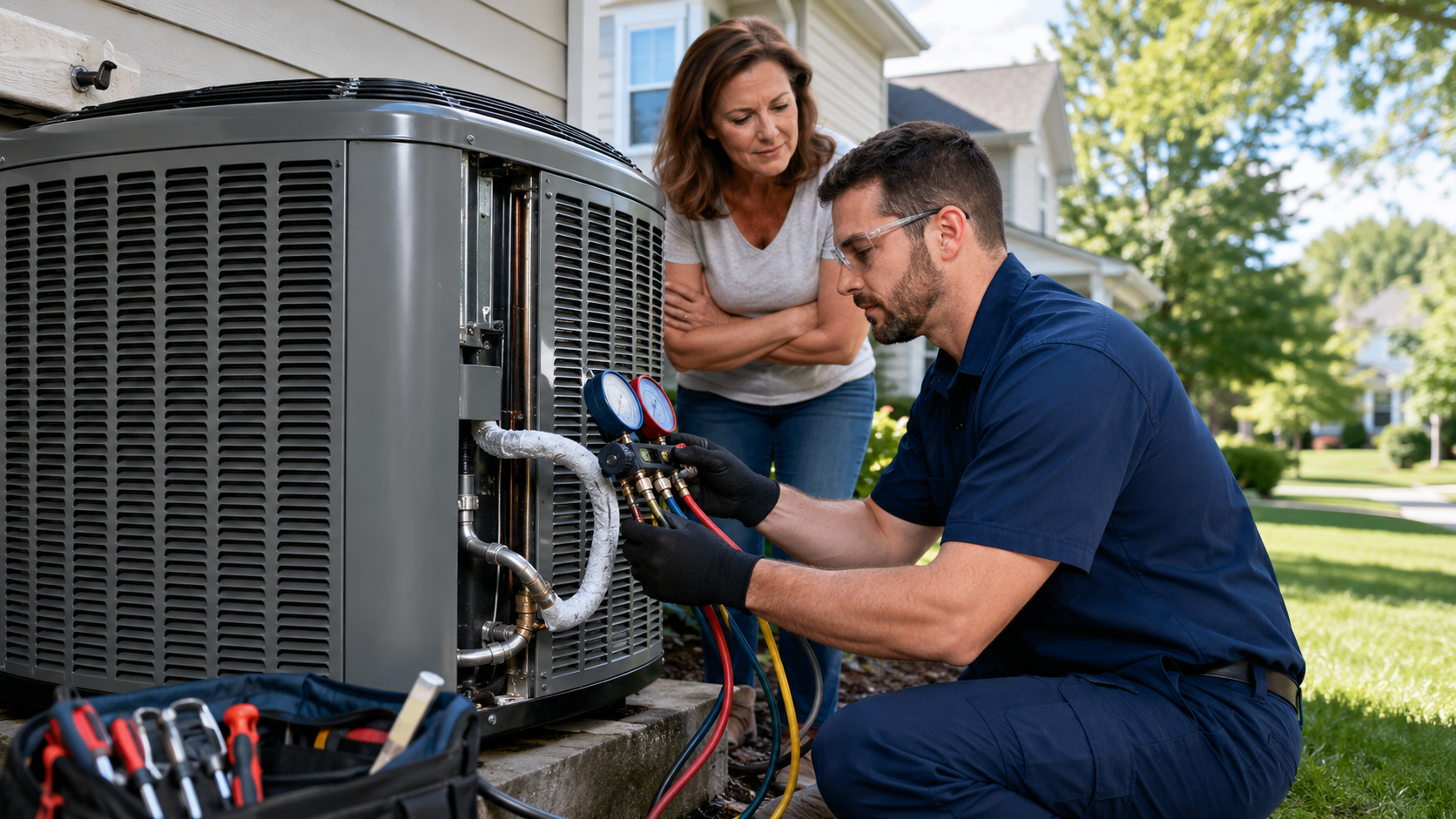
HVAC technician compares single-stage, two-stage and variable-speed systems for better home comfort

A refrigerant leak can turn a simple cooling problem into a larger repair decision. The total cost depends on the leak location, failed component, refrigerant type, system size, access, and whether repairing an older system makes financial sense.

Quick Answer

A refrigerant leak repair may involve leak detection, component or line repair, system preparation, the correct refrigerant charge, and performance testing. A recharge by itself does not repair a leak. Exact pricing requires diagnosis because an accessible connection and a leaking coil are materially different jobs.

Fast Decision Guide

AC was recently recharged?

Ask for leak detection before authorizing another recharge.

Ice on the system?

Turn off cooling and schedule diagnosis; continued operation can create additional damage.

Older AC with a major leak?

Compare repair and replacement before investing in a large coil or refrigerant expense.

Why Homeowners Call 1st Choice Heating & Cooling

  • Licensed and insured HVAC technicians
  • Straightforward explanations before major repair or replacement decisions
  • Residential heating, cooling, and indoor air quality expertise
  • Serving Waukesha, Muskego, and nearby communities within the confirmed service area
  • Financing options available for qualifying installations

What Goes Into AC Refrigerant Leak Repair Cost?

A refrigerant leak repair is not one standardized service. Cost depends on where the leak is located, how difficult it is to access, which component is damaged, the refrigerant used by the system, and whether the equipment remains a sound repair candidate.

A complete diagnosis may involve electronic leak detection, pressure testing, inspection of coils and line connections, and confirmation that airflow or another system problem is not producing similar symptoms.

Refrigerant Leak Cost Factors

Cost factor Why it matters
Leak location Accessible fittings are typically simpler to repair than leaks inside a coil or concealed line set
Failed component A damaged valve or connection is different from a leaking evaporator or condenser coil
Refrigerant type Availability, equipment requirements, and the amount needed affect the recharge portion
System size Larger systems may require a greater refrigerant charge
Access and labor Finished walls, tight mechanical areas, and difficult equipment access can increase labor
System age and condition An aging system with a major leak may justify comparing replacement before authorizing repair

Why a Recharge Alone Is Not a Complete Repair

Air conditioners are closed systems. Under normal operation, refrigerant is not consumed like fuel. If the refrigerant level is low, the system should be evaluated for a leak or another underlying problem.

Adding refrigerant without addressing the leak may provide temporary cooling, but it does not correct the source of the loss. A responsible repair sequence is diagnosis, leak-location confirmation, repair when practical, evacuation or required preparation, correct charging, and performance testing.

Signs Your AC May Have a Refrigerant Leak

  • Warm air or reduced cooling
  • Long cooling cycles
  • Ice on the evaporator coil or refrigerant line
  • Hissing or bubbling sounds near equipment
  • Higher energy use without a clear reason
  • A system that was previously recharged and is low again

Repair, Recharge, or Replace?

Situation Likely next conversation
Repairable fitting or accessible line leak on a sound system Repair the leak, charge correctly, and test performance
Leaking coil on a newer system with warranty coverage Compare warranty, labor, refrigerant, and repair scope
Major leak on older equipment Compare total repair cost with replacement value
Repeated refrigerant loss Do not continue recharging without locating the source
Obsolete or costly refrigerant on aging equipment Evaluate compatibility, future serviceability, and replacement options

What If the AC Uses R-22?

R-22 was phased out for new production and import in the United States. Recovered or reclaimed refrigerant may still be available, but availability and cost can affect the repair decision. An R-22 system is also likely to be older, so the equipment’s overall condition matters.

For older systems, combine the refrigerant decision with the framework in AC repair vs. replacement rather than evaluating recharge cost alone.

What Not to Do When the AC Is Low on Refrigerant

  • Do not keep operating a frozen system
  • Do not assume every warm-air problem is low refrigerant
  • Do not accept repeated recharges without a leak discussion
  • Do not compare estimates unless the diagnostic and repair scope match
  • Do not ignore coil, compressor, or airflow conditions that affect the long-term result

Frequently Asked Questions

How much does an AC refrigerant leak cost to repair?

Cost varies widely because the leak may be at a fitting, line, valve, evaporator coil, or condenser coil. Diagnosis is required before an accurate repair price can be given.

Can an AC refrigerant leak be repaired?

Many leaks can be repaired, but practicality depends on the location, damaged component, system age, refrigerant type, and total repair cost.

Is recharging the AC enough?

Not when refrigerant is escaping. Recharging may restore cooling temporarily, but the source of the leak still needs to be addressed.

Should I replace an AC with a refrigerant leak?

Replacement may deserve consideration when the system is older, uses R-22, has a failed coil, needs frequent repairs, or requires a large investment relative to replacement.

Is a refrigerant leak an emergency?

Loss of cooling during extreme heat, electrical symptoms, burning odors, or a system repeatedly tripping a breaker may require urgent service. Turn the system off if it is frozen or operating abnormally.

Schedule AC Refrigerant Leak Diagnosis

If the AC is freezing, hissing, blowing warm air, or repeatedly losing refrigerant, 1st Choice can locate the problem and explain the repair and replacement paths.

Single-Stage vs. Two-Stage vs. Variable-Speed HVAC Systems

modern HVAC options in a Wisconsin home

Choosing between single-stage, two-stage, and variable-speed HVAC equipment is not simply a choice between good, better, and best. The right system depends on the home, comfort goals, ductwork, budget, and how the equipment will be installed.

Quick Answer

Single-stage equipment usually has a lower initial cost and runs at one main output. Two-stage equipment adds a lower operating stage, while variable-speed or variable-capacity equipment adjusts more gradually. Advanced staging may improve temperature consistency, humidity management, and sound, but proper sizing and installation remain more important than buying the most complex system.

Fast Decision Guide

Focused on upfront cost?

Compare a properly sized single-stage system with the installed cost of staged alternatives.

Focused on comfort?

Ask how longer low-output cycles could affect temperature swings and summer humidity.

Replacing older equipment?

Confirm ductwork, electrical, thermostat, and equipment compatibility before choosing a system.

Why Homeowners Call 1st Choice Heating & Cooling

  • Licensed and insured HVAC technicians
  • Straightforward explanations before major repair or replacement decisions
  • Residential heating, cooling, and indoor air quality expertise
  • Serving Waukesha, Muskego, and nearby communities within the confirmed service area
  • Financing options available for qualifying installations

What Is the Difference Between Single-Stage, Two-Stage, and Variable-Speed HVAC?

The terms describe how an HVAC system changes its output. A single-stage system generally operates at one full-output level. A two-stage system can run at a lower stage during milder conditions and move to a higher stage when demand increases. A variable-speed or variable-capacity system can adjust output across a wider operating range.

The technology affects more than equipment price. It can change temperature consistency, humidity control, sound, runtime, electrical requirements, compatible controls, and the way the system responds to the home.

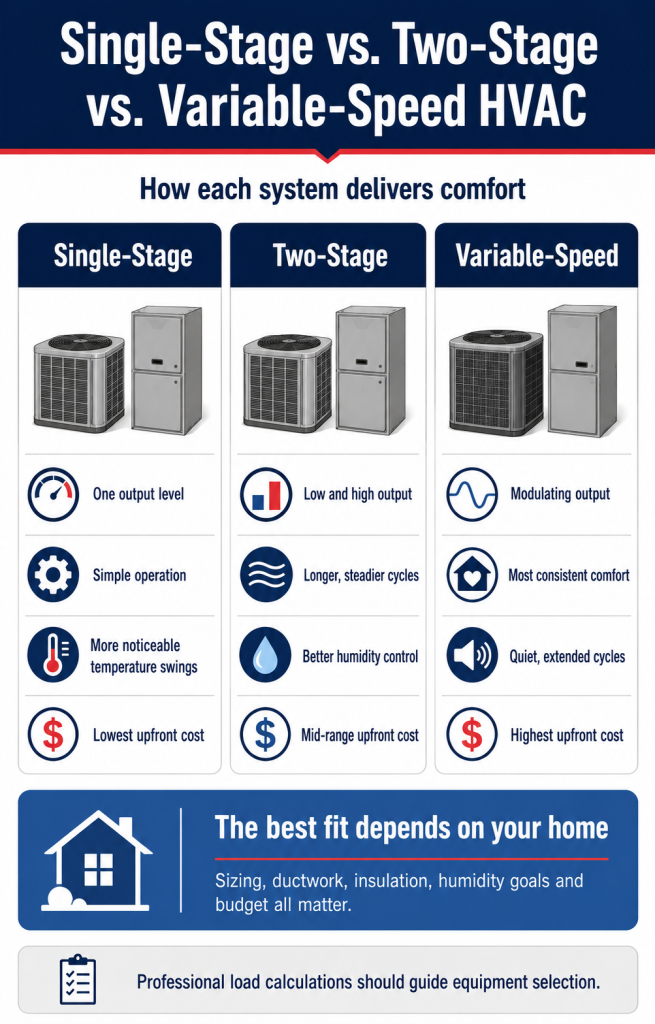
Single-stage, two-stage and variable-speed HVAC systems compared by comfort, humidity control, noise and upfront cost

HVAC Staging Comparison

System type How it operates Potential strength Important tradeoff
Single-stage Runs at one primary output level Simpler equipment and a lower initial cost in many cases Larger temperature swings and more noticeable cycling may occur
Two-stage Uses a lower and higher operating stage Longer low-stage runtimes can improve comfort More components and controls than a single-stage system
Variable-speed Adjusts output across a broad range Steadier comfort, quieter operation, and stronger humidity management may be possible Higher initial cost and greater dependence on proper setup and compatible controls

How Staging Changes Comfort

A system does not need to run at full output every time the thermostat calls. During moderate weather, lower output can maintain temperature with longer, steadier cycles. That can reduce the hot-and-cold feeling created by short bursts of full-capacity operation.

Comfort still depends on correct sizing, ductwork, airflow, insulation, and installation quality. Advanced equipment cannot compensate for a system that is oversized or connected to restrictive ductwork.

Which Option Handles Wisconsin Humidity Best?

Longer cooling cycles generally give an air conditioner more time to remove moisture. Two-stage and variable-capacity equipment may run longer at lower output, which can help humidity control during warm, damp weather.

That does not make the most expensive option automatically correct. A properly sized single-stage system can still perform well. The decision should consider the home, existing ductwork, comfort complaints, budget, and how long the homeowner expects to keep the system.

Which HVAC System Is the Best Fit?

Homeowner priority Option worth comparing Why
Lower initial equipment cost Single-stage A simpler configuration may meet the need when comfort is already consistent
Fewer temperature swings Two-stage or variable-speed Lower-output operation may maintain temperature more steadily
Humidity control Two-stage or variable-capacity cooling Longer cycles may remove more moisture
Quiet operation Variable-speed Gradual operation may reduce abrupt starts and full-speed runtime
Older or limited ductwork Professional evaluation first Duct capacity and static pressure can limit the right equipment choice

Why Proper Sizing Matters More Than the Label

Oversized equipment may reach the thermostat setting quickly and shut off before it has run long enough to manage humidity. Undersized equipment may struggle during design temperatures. Before comparing stages, the contractor should evaluate the home’s heating and cooling load and inspect the duct system.

For cooling replacements, review how professional AC sizing works. For a complete installation discussion, visit the AC installation service page.

What to Compare in an HVAC Proposal

  • Exact model numbers and matched indoor/outdoor equipment
  • Heating and cooling capacity
  • Efficiency ratings
  • Thermostat and control requirements
  • Ductwork or airflow changes
  • Electrical scope
  • Labor and warranty terms
  • Commissioning and performance testing

Frequently Asked Questions

Is variable-speed HVAC worth the cost?

It may be worthwhile for homeowners who place a high value on consistent temperatures, humidity control, quieter operation, and long-term comfort. The value depends on the home and the installed price difference.

Does variable speed mean the fan runs all the time?

Not necessarily. Operating behavior depends on the equipment, thermostat, control settings, and system design.

Is a two-stage system more efficient than a single-stage system?

It may use energy more efficiently in some homes because it can operate at lower output during milder conditions. The actual result depends on sizing, installation, climate, and usage.

Can variable-speed equipment use existing ductwork?

Sometimes, but the duct system should be evaluated for airflow capacity, leakage, and static pressure before equipment is selected.

Which HVAC system is best for Wisconsin?

There is no universal best system. Wisconsin homes vary in size, insulation, ductwork, heating fuel, and comfort needs, so an in-home evaluation is the responsible starting point.

Compare HVAC Replacement Options

1st Choice Heating & Cooling can evaluate the home, existing equipment, ductwork, and comfort priorities before presenting appropriate replacement options.

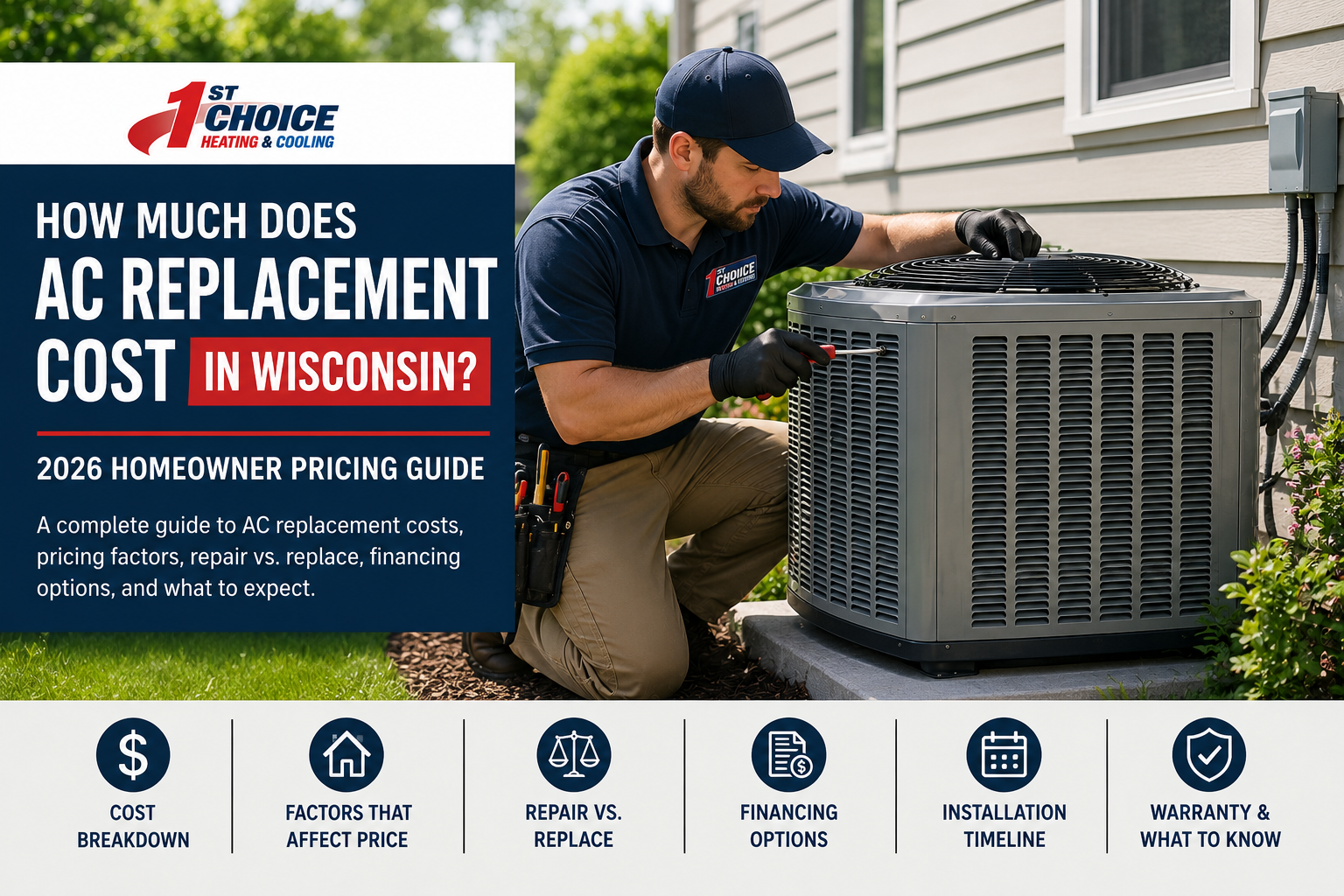
How Much Does AC Replacement Cost in Wisconsin? 2026 Homeowner Pricing Guide

AC replacement cost guide in Wisconsin

Replacing an air conditioner is a major home investment, and most homeowners want a clear idea of cost before scheduling an estimate. In Wisconsin, AC replacement cost depends on system size, efficiency rating, installation requirements, ductwork condition, and whether the existing equipment can be reused safely.

Quick Answer

Most AC replacement projects in Wisconsin can range from several thousand dollars to well over $10,000, depending on equipment size, efficiency, ductwork, electrical needs, and installation complexity. A basic replacement usually costs less than a full system upgrade, while high-efficiency systems, difficult access, or ductwork changes can increase the total.

Fast Decision Guide

Need Cooling Soon?

If your AC has failed during summer, start with an inspection to confirm whether repair or replacement makes more sense.

Comparing Quotes?

Do not compare price alone. Make sure equipment size, efficiency, warranty, labor, and installation details match.

Older System?

If your AC is 10–15+ years old and facing a major repair, replacement may offer better long-term value.

Why Homeowners Call 1st Choice Heating & Cooling

  • Licensed and insured HVAC technicians
  • Residential AC installation and replacement specialists
  • Serving Waukesha and surrounding Milwaukee-area communities
  • Repair-versus-replacement guidance before major decisions
  • Financing options available for qualifying installations

What Determines AC Replacement Cost?

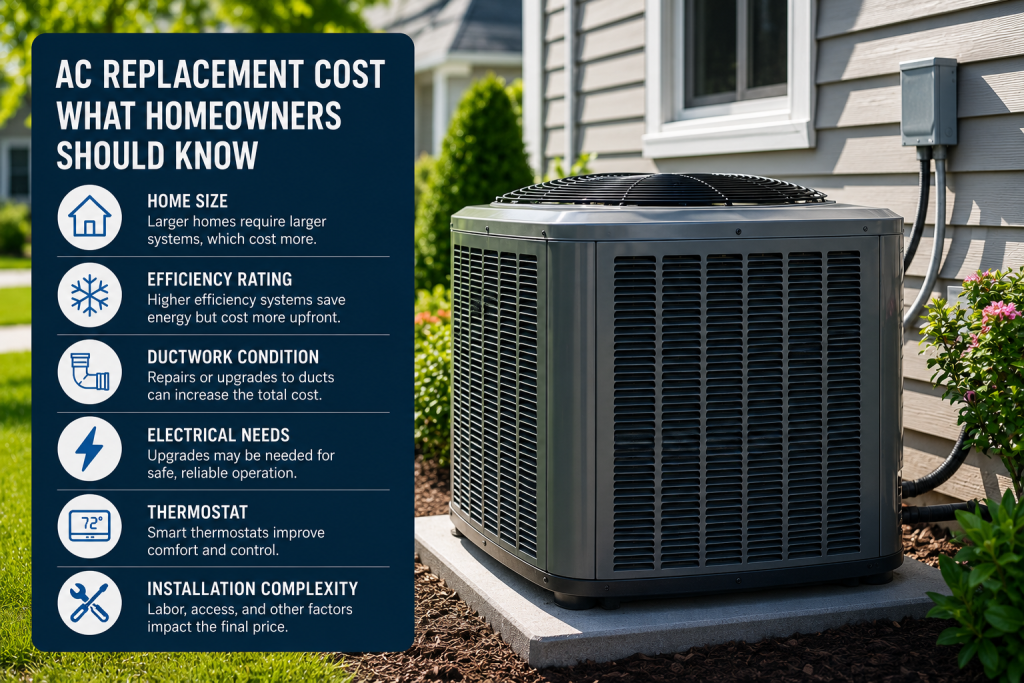
AC replacement cost guide for homeowners

The cost to replace an air conditioner is not based on the outdoor unit alone. A proper estimate considers the entire cooling system and how well it fits the home.

The biggest cost factors usually include:

  • Home size and cooling load
  • AC system size
  • Efficiency rating
  • Existing ductwork condition
  • Electrical requirements
  • Thermostat upgrades
  • Labor and installation complexity
  • Warranty and equipment options

The lowest quote is not always the best value if the system is incorrectly sized, poorly installed, or missing important installation details.

Typical AC Replacement Cost Factors

Cost Factor How It Affects Price
System Size Larger homes usually require larger cooling systems.
Efficiency Rating Higher-efficiency systems usually cost more upfront but may reduce operating costs.
Ductwork Condition Damaged, leaking, or undersized ducts can increase installation scope.
Electrical Needs Older electrical components may need updates for safe operation.
Installation Access Tight spaces or difficult equipment locations can add labor time.
Thermostat Smart thermostat upgrades can add cost but improve control.

Average AC Replacement Cost in Wisconsin

Most homeowners should expect AC replacement to fall into a broad range because homes and systems vary. A smaller, straightforward replacement will usually cost less than a larger high-efficiency system with ductwork or electrical updates.

Project Type Typical Cost Level Best Fit
Basic AC Replacement Lower Existing ductwork and electrical are in good condition.
Mid-Range AC Replacement Moderate Homeowner wants improved comfort and efficiency.
High-Efficiency Upgrade Higher Best for long-term efficiency and comfort improvements.
Full System Upgrade Highest May include ductwork, thermostat, electrical, or furnace pairing.

Exact pricing requires an in-home evaluation because system size, installation requirements, and equipment options can change the final cost.

Why AC Size Changes the Price

Choosing the right AC size is one of the most important parts of replacement.

A system that is too small may run constantly and still fail to cool the home. A system that is too large may short cycle, waste energy, and create humidity problems.

Professional sizing considers:

  • Square footage
  • Insulation
  • Window placement
  • Sun exposure
  • Ceiling height
  • Ductwork design
  • Home layout

If you are still comparing system sizes, this guide may help: What Size AC Unit Do I Need?

How Efficiency Rating Affects AC Replacement Cost

Higher-efficiency systems usually cost more upfront, but they may reduce energy use during Wisconsin summers.

Efficiency matters most if:

  • Your current AC runs constantly
  • Energy bills keep rising
  • Your system is more than 10–15 years old
  • Your home has uneven cooling
  • You plan to stay in the home long term

A higher-efficiency system is not always necessary for every home. The right choice depends on comfort goals, budget, expected length of ownership, and current system performance.

Should You Repair or Replace Your AC?

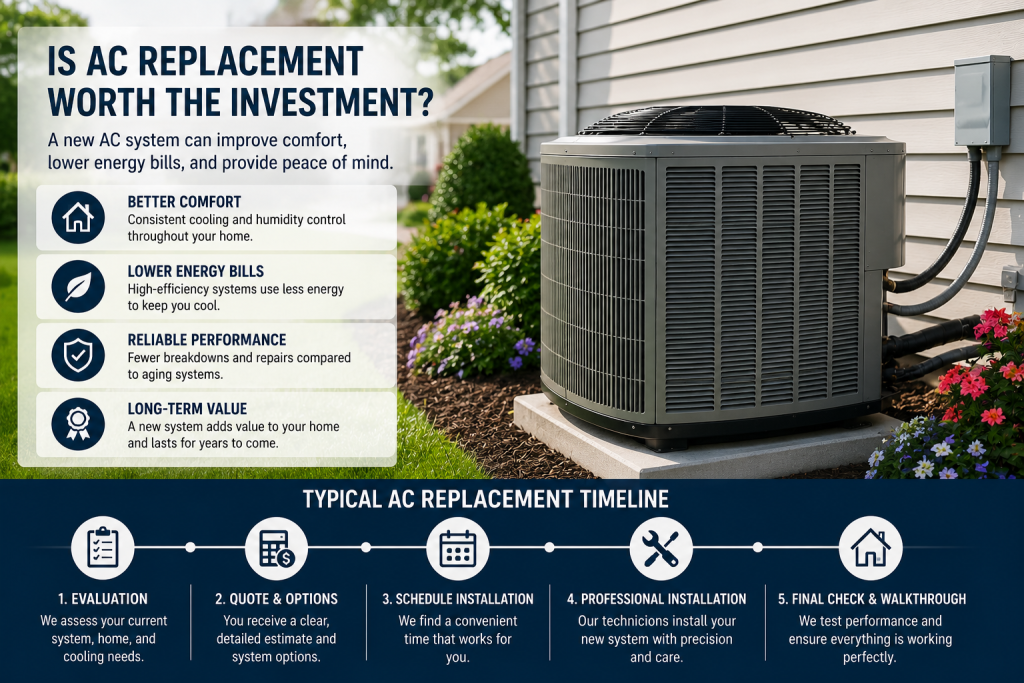
AC replacement benefits and timeline overview

Replacement is not always the right answer. In many cases, repairing the system makes more sense.

Repair May Make Sense If:

  • The AC is under 10 years old
  • The repair is isolated
  • Cooling performance is still strong
  • Energy bills are reasonable
  • The repair cost is manageable

Replacement May Make Sense If:

  • The AC is 10–15+ years old
  • Repairs are becoming frequent
  • Energy bills are rising
  • Major components have failed
  • The system struggles during summer heat

For a deeper breakdown, read AC Repair vs AC Replacement: How to Know Which Makes More Sense.

The 50% Rule for AC Replacement

A common HVAC guideline is the 50% rule.

If the repair cost is more than roughly half the cost of replacement, it may be smarter to put that money toward a new system instead of extending the life of aging equipment.

Situation Likely Direction
Minor repair on newer system Repair
Moderate repair on 10–12 year system Compare both options
Major repair on 15+ year system Replacement may make more sense
Compressor failure on older system Strong replacement consideration

If you are facing a major repair, review What Is the Most Expensive AC Repair?.

What AC Replacement Usually Includes

A proper AC replacement should include more than setting a new outdoor unit in place.

1 Review the existing cooling system and ductwork
2 Determine the correct equipment size
3 Remove the old air conditioning equipment
4 Install the new system and required components
5 Test airflow, refrigerant charge, and system operation
6 Review performance, thermostat settings, and maintenance needs

How Long Does AC Replacement Take?

Many standard AC replacements can be completed in one day, but timing depends on the complexity of the installation.

Projects may take longer if:

  • Ductwork changes are needed
  • Electrical updates are required
  • The system location is difficult to access
  • Additional equipment is being replaced
  • A high-efficiency system requires extra setup

The estimate process should clarify the expected timeline before installation begins.

Can Financing Help With AC Replacement Cost?

Financing can help homeowners replace aging equipment without paying the full project cost upfront.

This can be useful when:

  • The system fails unexpectedly
  • A major repair does not make financial sense
  • A higher-efficiency system is preferred
  • The homeowner wants predictable monthly payments

If financing is available, compare the monthly cost against expected repair risk, energy usage, comfort improvements, and warranty coverage.

How to Compare AC Replacement Quotes

When comparing HVAC quotes, the lowest price may not always be the best decision.

Look closely at:

Quote Detail Why It Matters
Equipment Size Incorrect sizing can create comfort and efficiency issues.
Efficiency Rating Impacts long-term operating cost.
Warranty Protects against future equipment issues.
Labor Scope Clarifies what is actually included.
Ductwork Review Prevents airflow problems after installation.
Thermostat Compatibility Ensures proper system control.

A quote should help you understand the full system, not just the equipment price.

Red Flags When Comparing AC Replacement Estimates

Be cautious if an estimate includes:

  • No explanation of system size
  • No discussion of ductwork or airflow
  • No written scope of work
  • Vague warranty details
  • Pressure to decide immediately
  • Pricing that seems unusually low without explanation

A clear estimate should reduce uncertainty, not create more questions.

Wisconsin Factors That Affect AC Replacement Decisions

In Wisconsin, AC systems often sit unused for part of the year, then work hard during summer heat and humidity.

That creates a few practical considerations:

  • Humidity control matters, not just temperature
  • Older homes may have ductwork limitations
  • Energy costs can rise quickly during heat waves
  • Spring and early summer are often better planning windows
  • Replacement decisions often happen after the first major breakdown of the season

If your AC is running constantly, freezing up, or driving up utility bills, replacement may be worth evaluating before the next heat wave.

Related resources:

What Waiting Too Long Can Cost

Delay Possible Result
Continuing major repairs More money spent on aging equipment
Waiting until total failure Emergency replacement pressure
Ignoring rising energy bills Higher monthly operating costs
Delaying during peak season Reduced scheduling flexibility

AC Replacement Service Areas

1st Choice Heating & Cooling provides AC installation and replacement services throughout:

Waukesha
Muskego
New Berlin
West Allis
Franklin
Oak Creek
Pewaukee
Greenfield
Milwaukee

AC Replacement Cost FAQs

How much does AC replacement cost in Wisconsin?

AC replacement cost varies based on equipment size, efficiency, ductwork, electrical needs, and installation complexity. A professional estimate is needed for accurate pricing.

What is the most expensive part of replacing an AC system?

Major equipment, labor, efficiency upgrades, and any needed ductwork or electrical changes usually have the biggest impact on total cost.

Is AC replacement worth it?

Replacement may be worth it if your system is old, inefficient, frequently breaking down, or facing a major repair.

How long do air conditioners last?

Most residential air conditioners last 10–15 years, depending on maintenance, usage, installation quality, and system condition.

Should I repair or replace my AC?

Repair often makes sense for newer systems with minor issues. Replacement may make more sense for older systems with major repair needs.

Can I replace only the outdoor AC unit?

Sometimes, but it depends on compatibility with the indoor coil, refrigerant type, system age, and manufacturer requirements.

Does a higher-efficiency AC cost more?

Usually yes. Higher-efficiency systems often cost more upfront but may reduce energy use over time.

What size AC do I need?

The right size depends on square footage, insulation, layout, windows, sun exposure, and ductwork. Professional sizing is recommended.

How long does AC installation take?

Many standard installations can be completed in one day, but complex replacements may take longer.

Can financing help with AC replacement?

Financing may help homeowners spread the cost of replacement over time, depending on available options and qualification.

Should I replace my furnace and AC at the same time?

Sometimes it makes sense if both systems are aging or if compatibility, efficiency, or labor savings are important factors.

What causes AC replacement costs to increase?

Ductwork problems, electrical updates, difficult access, higher efficiency equipment, and improper existing installation can increase project cost.

When is the best time to replace an AC?

Many homeowners prefer spring or early summer before peak heat, but replacement may be needed anytime the system fails or becomes too expensive to repair.

Can a new AC lower my electric bill?

A properly sized, efficient new system may reduce energy use compared to an older, struggling system.

What should be included in an AC replacement estimate?

A good estimate should include equipment details, system size, labor scope, warranty, thermostat needs, ductwork considerations, and total project cost.

Get an AC Replacement Estimate in Waukesha, WI

If your air conditioner is aging, breaking down, or becoming expensive to repair, the simplest next step is a professional replacement estimate. 1st Choice Heating & Cooling can evaluate your current system, explain your options, and help you choose the right cooling solution for your home.

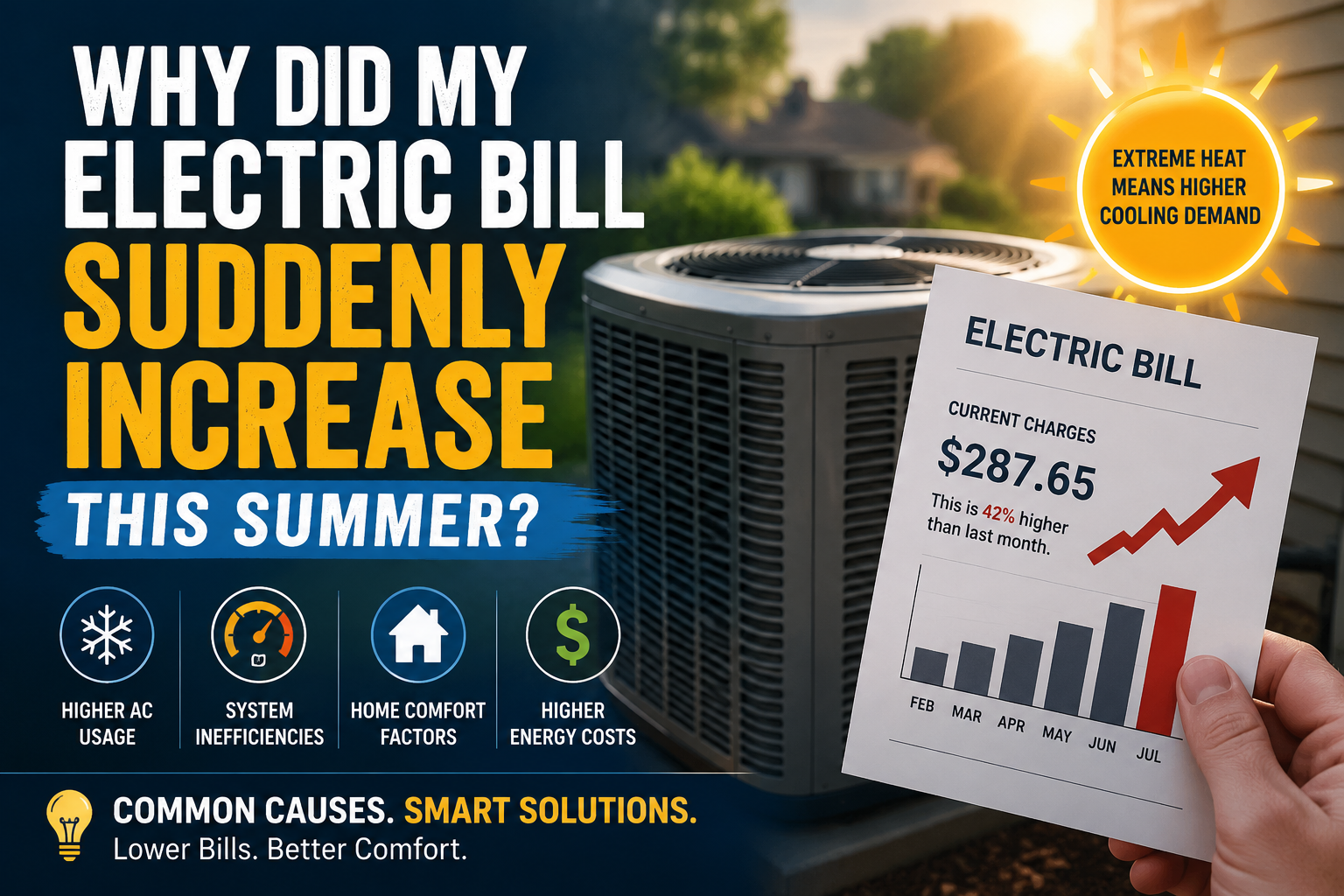
Why Did My Electric Bill Suddenly Increase This Summer?

Why electric bills rise in summer?

If your electric bill suddenly increased this summer, your air conditioner may be working harder than it should. While hot weather naturally increases cooling demand, a significant jump in energy costs often points to efficiency problems, maintenance issues, or aging HVAC equipment.

Quick Answer

A sudden increase in your electric bill is often caused by an air conditioner running longer than necessary due to dirty filters, low refrigerant, aging equipment, thermostat issues, poor insulation, or deferred maintenance. Identifying the cause early can help prevent higher operating costs and unnecessary system wear.

Fast Decision Guide

Bill Up Slightly?

Higher temperatures and increased AC usage may be responsible.

Bill Up Dramatically?

An HVAC efficiency issue may be causing excessive energy use.

Older AC System?

Aging equipment often becomes significantly less efficient over time.

Why Homeowners Call 1st Choice Heating & Cooling

  • Licensed and insured HVAC technicians
  • Residential cooling system specialists
  • Serving Waukesha and surrounding communities
  • Same-day service available in many cases
  • Honest recommendations focused on efficiency and comfort

Why Summer Electric Bills Often Spike

Your air conditioner is typically the largest energy consumer in your home during summer.

When outdoor temperatures rise, cooling systems naturally run longer. However, if your bill increases far beyond normal seasonal changes, the system may be operating inefficiently.

The challenge is determining whether the increase is weather-related or a sign that your HVAC system needs attention.

Common Reasons Your Electric Bill Increased

Dirty Air Filters

One of the simplest causes is also one of the most common.

A clogged filter restricts airflow, forcing the system to work harder.

  • Longer cooling cycles
  • Higher energy use
  • Reduced airflow
  • Increased system strain

Air Conditioner Running Constantly

If your system never seems to shut off, it may be struggling to maintain indoor temperatures.

You may also want to read:
Why Is My AC Running Constantly But Not Cooling My House?

Low Refrigerant Levels

When refrigerant levels are low, cooling efficiency drops and the system runs longer to achieve the same results.

Dirty Condenser Coils

The outdoor unit must release heat effectively.

When condenser coils become dirty, cooling performance declines and energy consumption increases.

Aging Equipment

Older systems often consume significantly more electricity than newer, high-efficiency equipment.

If your system is approaching the end of its expected lifespan, you may benefit from reviewing:
How Long Do Air Conditioners Last in Wisconsin?

How HVAC Problems Affect Utility Costs

Issue Potential Energy Impact
Dirty Air Filter Higher run times and reduced airflow
Low Refrigerant Significant efficiency loss
Dirty Coils Poor heat transfer
Aging Equipment Higher monthly operating costs
Thermostat Problems Unnecessary cooling cycles

Things You Can Check First

  1. Replace the air filter
  2. Verify thermostat settings
  3. Inspect outdoor equipment for debris
  4. Check for blocked supply vents
  5. Compare usage to previous summers
  6. Schedule maintenance if overdue

Can You Wait or Should You Schedule Service?

Usually OK To Monitor

Minor bill increase during unusually hot weather.

Schedule Service Soon

Noticeably higher bills combined with reduced cooling performance.

Call Immediately

Warm air, frozen coils, unusual noises, or significant cooling loss.

What We Commonly See During Wisconsin Summers

Many homeowners first notice HVAC issues when utility bills arrive.

Systems that appear to be cooling normally may actually be running significantly longer than necessary due to dirty filters, deferred maintenance, refrigerant issues, or age-related efficiency decline.

Can Maintenance Lower Energy Bills?

In many cases, yes.

Routine maintenance helps identify issues before they become larger efficiency problems.

Benefits often include:

  • Improved airflow
  • Cleaner coils
  • Better system performance
  • Reduced equipment strain
  • Lower operating costs

When High Energy Bills May Point Toward Replacement

If your system is older and utility costs continue increasing every year, replacement may be worth evaluating.

Common indicators include:

  • System is 15+ years old
  • Frequent repair visits
  • Cooling performance decline
  • Consistently rising energy costs
  • Major component wear

High Electric Bill FAQs

Can my air conditioner cause my electric bill to increase?

Yes. Cooling systems are often the largest contributor to summer energy usage.

Will changing my air filter reduce energy costs?

A clean filter can improve airflow and help the system operate more efficiently.

Can low refrigerant increase energy bills?

Yes. The system often runs longer and works harder when refrigerant levels are low.

Why is my AC running all day?

Restricted airflow, refrigerant issues, dirty coils, or aging equipment may be responsible.

How often should AC maintenance be performed?

Most homeowners benefit from annual professional maintenance.

When should I replace an older AC system?

If repairs become frequent and operating costs continue rising, replacement may provide better long-term value.

Concerned About Rising Cooling Costs?

If your electric bill has increased unexpectedly and your air conditioner seems to be working harder than normal, the simplest next step is scheduling a professional inspection to identify the cause.

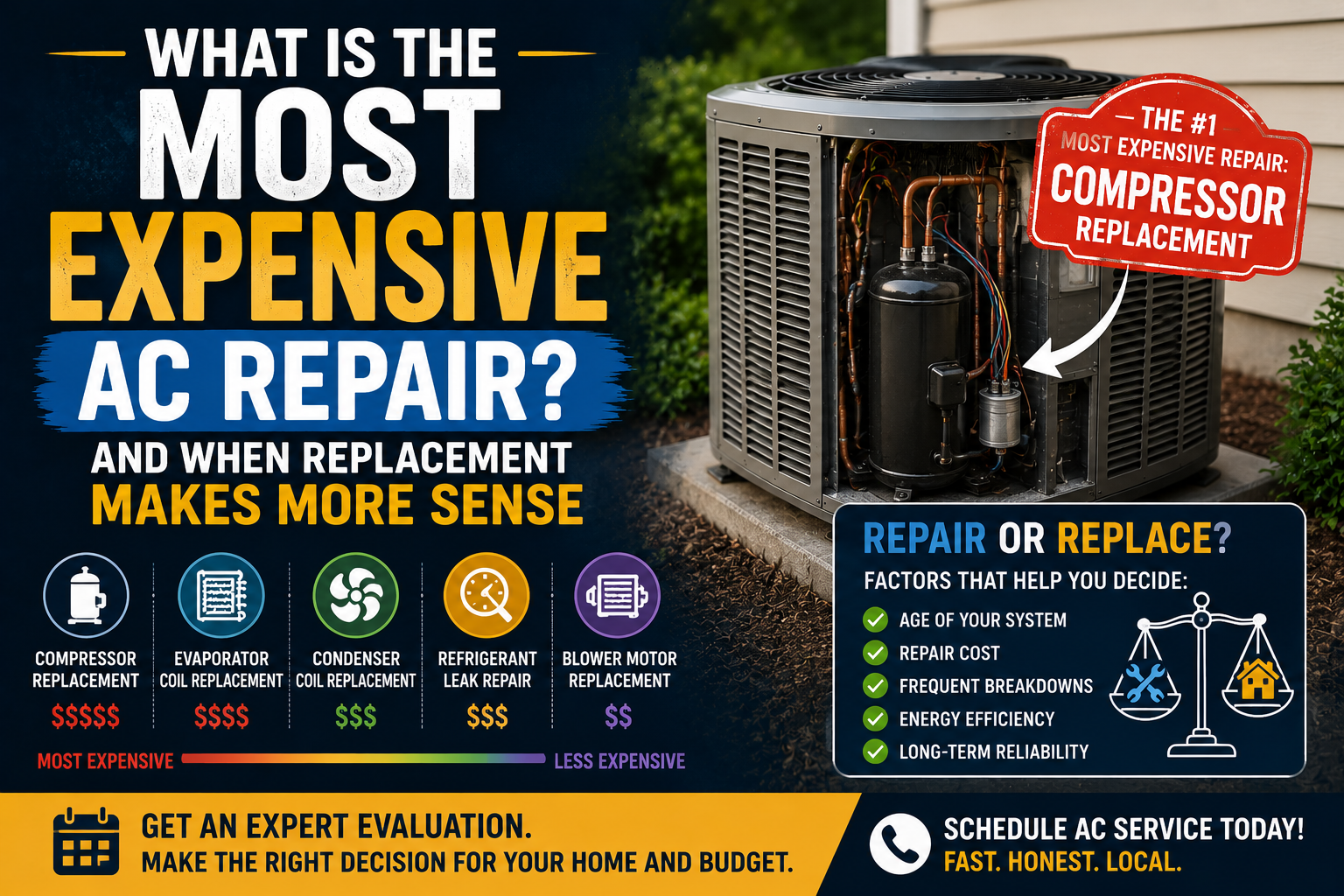
What Is the Most Expensive AC Repair?

What is the most expensive AC repair?

Few things catch homeowners off guard faster than a major air conditioning repair. While some AC problems can be fixed relatively affordably, others involve critical components that can significantly impact the cost of restoring your system.

Quick Answer

The compressor is often the most expensive air conditioning repair. Depending on the system, compressor replacement can cost thousands of dollars and may lead homeowners to consider replacing the entire unit, especially if the system is older or already experiencing other issues.

Fast Decision Guide

Minor Repair Needed?

Capacitors, contactors, and thermostats are often repairable at a much lower cost.

Compressor Failure?

This is often the most expensive repair homeowners face.

Older System?

Replacement may provide better long-term value than a major repair.

Why Homeowners Call 1st Choice Heating & Cooling

  • Licensed and insured HVAC technicians
  • Honest repair-versus-replacement recommendations
  • Residential cooling system specialists
  • Serving Waukesha and surrounding communities
  • Same-day service available in many cases

Not All AC Repairs Cost the Same

Many cooling issues involve relatively small components that can be repaired without major expense.

However, certain parts play such a critical role in system operation that failure can dramatically increase repair costs.

Understanding which repairs are most expensive helps homeowners make informed decisions when problems arise.

The Most Expensive AC Repairs

Repair Type Typical Cost Impact Replacement Consideration?
Compressor Replacement Very High Often Yes
Evaporator Coil Replacement High Sometimes
Condenser Coil Replacement High Sometimes
Refrigerant Leak Repair Moderate to High Depends on Age
Blower Motor Replacement Moderate Usually No

Compressor Failure

The compressor is often considered the heart of the air conditioning system.

Its job is to circulate refrigerant throughout the cooling cycle.

When a compressor fails:

  • Cooling stops completely
  • Repairs become complex
  • Labor requirements increase
  • Replacement costs can be significant

For older systems, compressor replacement often leads to a broader replacement discussion.

Evaporator Coil Replacement

The evaporator coil absorbs heat from inside your home.

Over time, corrosion, leaks, or age-related wear can cause failures that require replacement.

Condenser Coil Damage

The outdoor coil releases heat collected from inside the home.

Physical damage, corrosion, or age can sometimes lead to costly repairs.

Refrigerant Leaks

While some leaks are relatively minor, locating and repairing larger leaks can become expensive depending on the system design and extent of damage.

If you’re currently evaluating repair costs, you may also find this helpful:

What Does AC Repair Cost in Waukesha, WI?

What Makes Certain Repairs Expensive?

Factor Why Cost Increases
Parts Availability Older systems may require harder-to-source components
Labor Complexity Major components require extensive labor
System Age Additional failures may be approaching
Refrigerant Requirements Some refrigerants are more costly to service

Repair or Replace?

Usually Repair

Minor component failures on relatively newer equipment.

Evaluate Carefully

Moderate repairs on systems approaching 10–15 years old.

Consider Replacement

Compressor failure or multiple major repairs on older equipment.

When Replacement May Be the Better Investment

Major repairs do not automatically mean replacement is necessary.

However, replacement may make sense when:

  • The system is over 15 years old
  • Repair costs continue increasing
  • Efficiency has declined
  • Comfort problems are becoming common
  • Major components have failed

If you’re weighing both options, you may also want to review:

Repair vs Replacement Considerations

What We Commonly See in Wisconsin Homes

Many homeowners begin evaluating replacement when an older system experiences its first major repair.

The decision often comes down to balancing:

  • Current repair costs
  • Future reliability
  • Energy efficiency
  • Long-term operating expenses

Expensive AC Repair FAQs

What is the most expensive AC repair?

Compressor replacement is often the most expensive air conditioning repair homeowners encounter.

Should I replace my AC if the compressor fails?

It depends on the system’s age, condition, and overall repair costs.

How long should an AC compressor last?

Many compressors last 10–15 years when properly maintained.

Is replacing an evaporator coil worth it?

That depends on the age of the system and the overall condition of the equipment.

How do I know if repair or replacement makes more sense?

Age, repair costs, efficiency, and future reliability should all be evaluated together.

Do older AC systems cost more to repair?

Often yes, especially when replacement parts become harder to source.

Can maintenance help prevent major repairs?

Routine maintenance can identify smaller issues before they become larger failures.

Facing a Major AC Repair?

If you’ve been given a repair estimate and aren’t sure whether repairing or replacing your system makes more sense, the simplest next step is a professional evaluation of the equipment and your available options.