
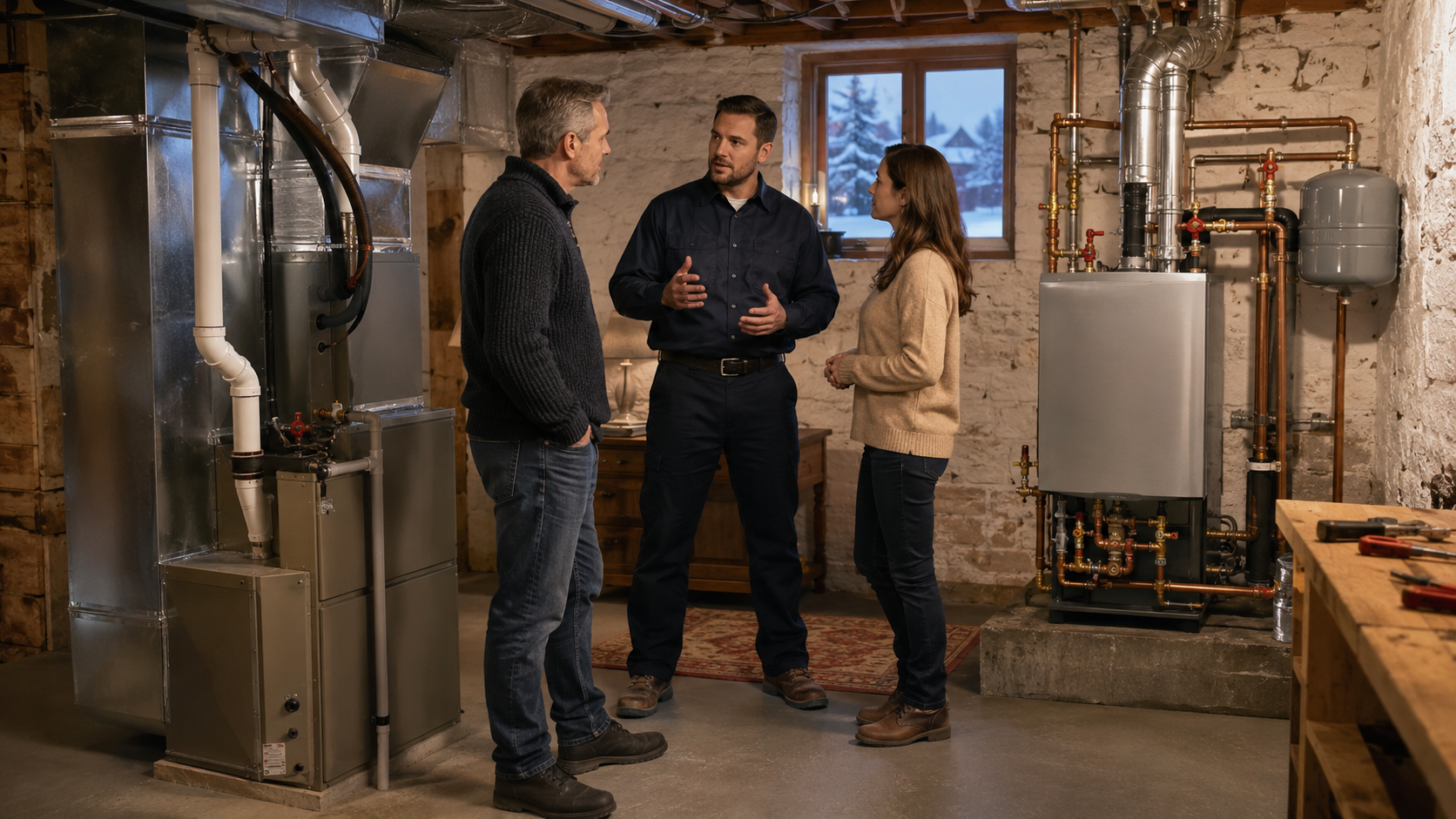
When one half of a home’s heating and cooling system fails, homeowners often wonder whether replacing the furnace and air conditioner together is smarter than replacing only the failed equipment. The answer depends on age, compatibility, condition, efficiency goals, budget, and the likelihood of paying for another installation soon.
Quick Answer
Replacing the furnace and AC together can make sense when both systems are aging, equipment compatibility limits the available options, or one combined installation avoids repeating labor and disruption. Replacing only the failed system may be better when the other system is newer, compatible, and performing reliably.
Fast Decision Guide
Systems close in age?
Price both a single-system and combined replacement before deciding.
One system still fairly new?
Confirm equipment compatibility and expected remaining life before replacing it early.
Budget is the constraint?
Compare the cost of phasing with the risk of a second breakdown and installation.
Why Homeowners Call 1st Choice Heating & Cooling
- Licensed and insured HVAC technicians
- Straightforward explanations before major repair or replacement decisions
- Residential heating, cooling, and indoor air quality expertise
- Serving Waukesha, Muskego, and nearby communities within the confirmed service area
- Financing options available for qualifying installations
When Replacing the Furnace and AC Together Can Make Sense
A furnace and central air conditioner often share the indoor blower, duct system, thermostat, and part of the installation workspace. Replacing both together can simplify compatibility decisions and reduce repeated disruption, but it also increases the immediate project scope.
The correct decision depends on the age and condition of each system. A failed AC does not automatically make a newer furnace obsolete, and a failed furnace does not always require AC replacement.
Replace One System or Both?
| Situation | Replace one may make sense | Replacing both deserves consideration |
|---|---|---|
| One system is relatively new | The newer equipment is compatible and performing well | Compatibility or refrigerant requirements create limitations |
| Both systems are near the end of expected service life | Budget requires phasing and the remaining system is reliable | Avoiding a second installation and breakdown is a priority |
| Major efficiency upgrade | The retained system supports the planned equipment | Matched equipment or controls are needed for the desired performance |
| Home comfort problems | The problem is isolated to one piece of equipment | Airflow, blower, controls, and both systems contribute to the issue |
| Upcoming home sale or short ownership horizon | A targeted repair or replacement meets the need | Reliability and transferable warranty value justify the broader scope |
Why HVAC Compatibility Matters
The outdoor AC, indoor evaporator coil, furnace blower, thermostat, and controls must work together. Equipment combinations can affect capacity, efficiency ratings, refrigerant requirements, airflow, and warranty terms.
Before retaining one system, the proposal should identify the exact equipment match and explain whether the published performance rating applies to that combination.
Potential Cost Advantages of One Combined Project
- One mobilization and project schedule
- One equipment-selection and permitting process when applicable
- Reduced duplication of some labor tasks
- One coordinated thermostat and control setup
- Less chance of opening the same mechanical area again soon
Reasons Not to Replace Both Automatically
- The second system is newer and reliable
- The combined project creates unnecessary financial strain
- The retained system is fully compatible
- The homeowner plans to change heating fuel or home configuration later
- The desired upgrade can be completed without compromising performance
Questions to Ask Before Deciding
| Question | What the answer reveals |
|---|---|
| How old is each system? | Whether the remaining useful life is similar or far apart |
| Are the proposed indoor and outdoor components matched? | Whether capacity and efficiency claims are supportable |
| Will the existing blower deliver the required airflow? | Whether retaining the furnace affects cooling performance |
| Would phasing change labor or equipment options later? | The cost of delaying the second replacement |
| What warranties apply to each option? | How risk differs between one-system and full-system replacement |
| What happens if the retained system fails next year? | The practical second-order cost of phasing |
A Practical Decision Rule
Price both pathways when the systems are similar in age or when compatibility is uncertain. Compare the one-system proposal with the combined proposal using the same scope: equipment, controls, ductwork, electrical work, warranty, labor, and commissioning.
If the AC is the immediate concern, start with the Wisconsin AC replacement cost guide. If the furnace is driving the decision, review furnace installation and replacement options.
Frequently Asked Questions
Should I replace my furnace and AC at the same time?
It may make sense when both are aging, compatibility matters, or the combined project reduces repeated labor. It is not automatically necessary when one system is newer and reliable.
Can I replace the AC without replacing the furnace?
Often yes, if the furnace blower, indoor coil arrangement, controls, and proposed outdoor equipment are compatible.
Does replacing both save money?
A combined project may reduce duplicated labor or future disruption, but the total immediate cost is higher. Compare written scopes rather than assuming savings.
What if my furnace works but is old?
Ask for its condition, safety, blower performance, and expected remaining life to be evaluated before deciding.
Can I replace the furnace now and AC later?
Sometimes. The contractor should explain how today’s furnace and coil selection affects future AC compatibility and efficiency.
Compare One-System and Full-System Replacement
1st Choice can evaluate both systems, explain compatibility, and provide options that match the home and budget without replacing working equipment automatically.
