
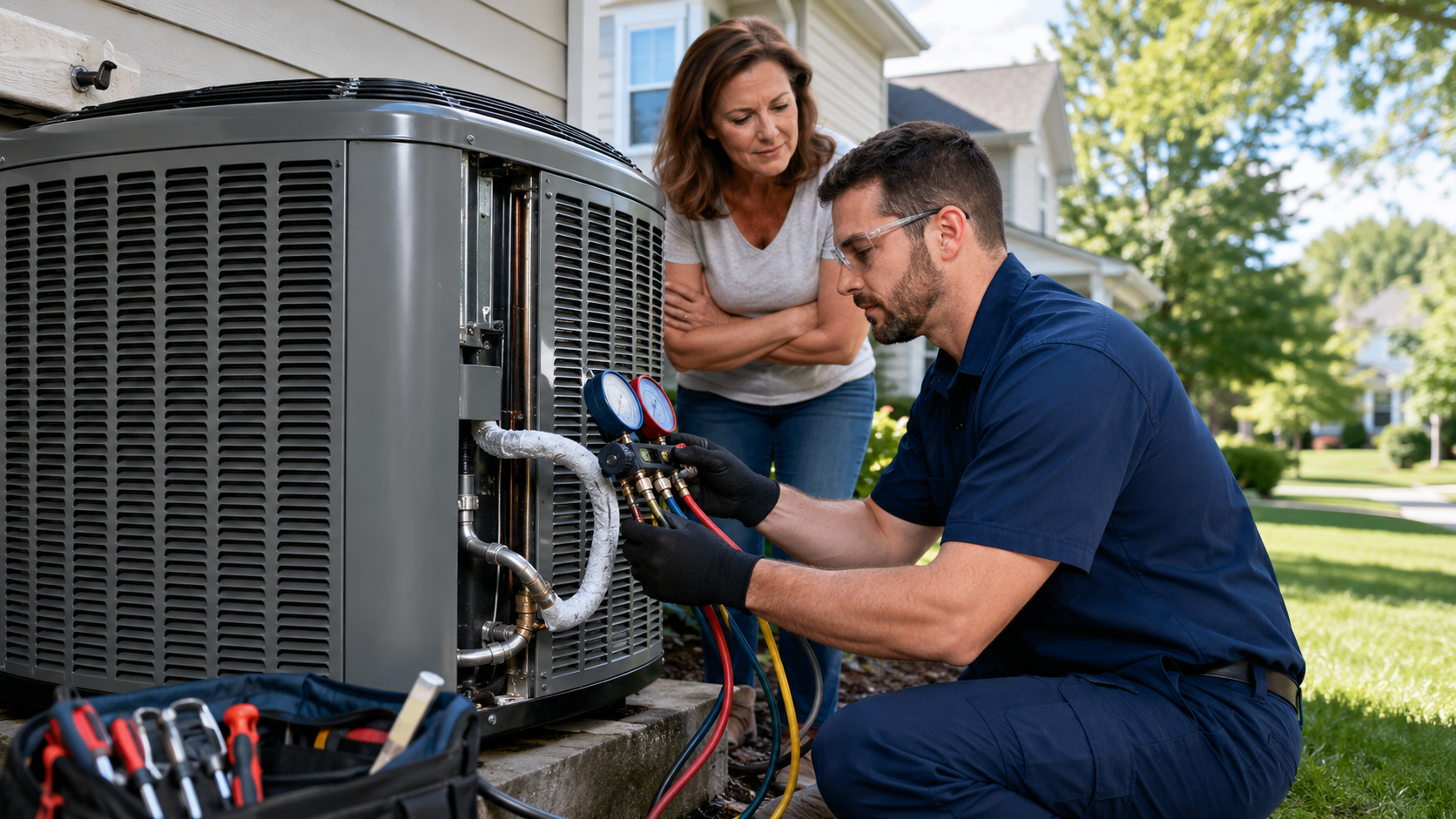
A refrigerant leak can turn a simple cooling problem into a larger repair decision. The total cost depends on the leak location, failed component, refrigerant type, system size, access, and whether repairing an older system makes financial sense.
Quick Answer
A refrigerant leak repair may involve leak detection, component or line repair, system preparation, the correct refrigerant charge, and performance testing. A recharge by itself does not repair a leak. Exact pricing requires diagnosis because an accessible connection and a leaking coil are materially different jobs.
Fast Decision Guide
AC was recently recharged?
Ask for leak detection before authorizing another recharge.
Ice on the system?
Turn off cooling and schedule diagnosis; continued operation can create additional damage.
Older AC with a major leak?
Compare repair and replacement before investing in a large coil or refrigerant expense.
Why Homeowners Call 1st Choice Heating & Cooling
- Licensed and insured HVAC technicians
- Straightforward explanations before major repair or replacement decisions
- Residential heating, cooling, and indoor air quality expertise
- Serving Waukesha, Muskego, and nearby communities within the confirmed service area
- Financing options available for qualifying installations
What Goes Into AC Refrigerant Leak Repair Cost?
A refrigerant leak repair is not one standardized service. Cost depends on where the leak is located, how difficult it is to access, which component is damaged, the refrigerant used by the system, and whether the equipment remains a sound repair candidate.
A complete diagnosis may involve electronic leak detection, pressure testing, inspection of coils and line connections, and confirmation that airflow or another system problem is not producing similar symptoms.
Refrigerant Leak Cost Factors
| Cost factor | Why it matters |
|---|---|
| Leak location | Accessible fittings are typically simpler to repair than leaks inside a coil or concealed line set |
| Failed component | A damaged valve or connection is different from a leaking evaporator or condenser coil |
| Refrigerant type | Availability, equipment requirements, and the amount needed affect the recharge portion |
| System size | Larger systems may require a greater refrigerant charge |
| Access and labor | Finished walls, tight mechanical areas, and difficult equipment access can increase labor |
| System age and condition | An aging system with a major leak may justify comparing replacement before authorizing repair |
Why a Recharge Alone Is Not a Complete Repair
Air conditioners are closed systems. Under normal operation, refrigerant is not consumed like fuel. If the refrigerant level is low, the system should be evaluated for a leak or another underlying problem.
Adding refrigerant without addressing the leak may provide temporary cooling, but it does not correct the source of the loss. A responsible repair sequence is diagnosis, leak-location confirmation, repair when practical, evacuation or required preparation, correct charging, and performance testing.
Signs Your AC May Have a Refrigerant Leak
- Warm air or reduced cooling
- Long cooling cycles
- Ice on the evaporator coil or refrigerant line
- Hissing or bubbling sounds near equipment
- Higher energy use without a clear reason
- A system that was previously recharged and is low again
Repair, Recharge, or Replace?
| Situation | Likely next conversation |
|---|---|
| Repairable fitting or accessible line leak on a sound system | Repair the leak, charge correctly, and test performance |
| Leaking coil on a newer system with warranty coverage | Compare warranty, labor, refrigerant, and repair scope |
| Major leak on older equipment | Compare total repair cost with replacement value |
| Repeated refrigerant loss | Do not continue recharging without locating the source |
| Obsolete or costly refrigerant on aging equipment | Evaluate compatibility, future serviceability, and replacement options |
What If the AC Uses R-22?
R-22 was phased out for new production and import in the United States. Recovered or reclaimed refrigerant may still be available, but availability and cost can affect the repair decision. An R-22 system is also likely to be older, so the equipment’s overall condition matters.
For older systems, combine the refrigerant decision with the framework in AC repair vs. replacement rather than evaluating recharge cost alone.
What Not to Do When the AC Is Low on Refrigerant
- Do not keep operating a frozen system
- Do not assume every warm-air problem is low refrigerant
- Do not accept repeated recharges without a leak discussion
- Do not compare estimates unless the diagnostic and repair scope match
- Do not ignore coil, compressor, or airflow conditions that affect the long-term result
Frequently Asked Questions
How much does an AC refrigerant leak cost to repair?
Cost varies widely because the leak may be at a fitting, line, valve, evaporator coil, or condenser coil. Diagnosis is required before an accurate repair price can be given.
Can an AC refrigerant leak be repaired?
Many leaks can be repaired, but practicality depends on the location, damaged component, system age, refrigerant type, and total repair cost.
Is recharging the AC enough?
Not when refrigerant is escaping. Recharging may restore cooling temporarily, but the source of the leak still needs to be addressed.
Should I replace an AC with a refrigerant leak?
Replacement may deserve consideration when the system is older, uses R-22, has a failed coil, needs frequent repairs, or requires a large investment relative to replacement.
Is a refrigerant leak an emergency?
Loss of cooling during extreme heat, electrical symptoms, burning odors, or a system repeatedly tripping a breaker may require urgent service. Turn the system off if it is frozen or operating abnormally.
Schedule AC Refrigerant Leak Diagnosis
If the AC is freezing, hissing, blowing warm air, or repeatedly losing refrigerant, 1st Choice can locate the problem and explain the repair and replacement paths.
