
Quick Answer
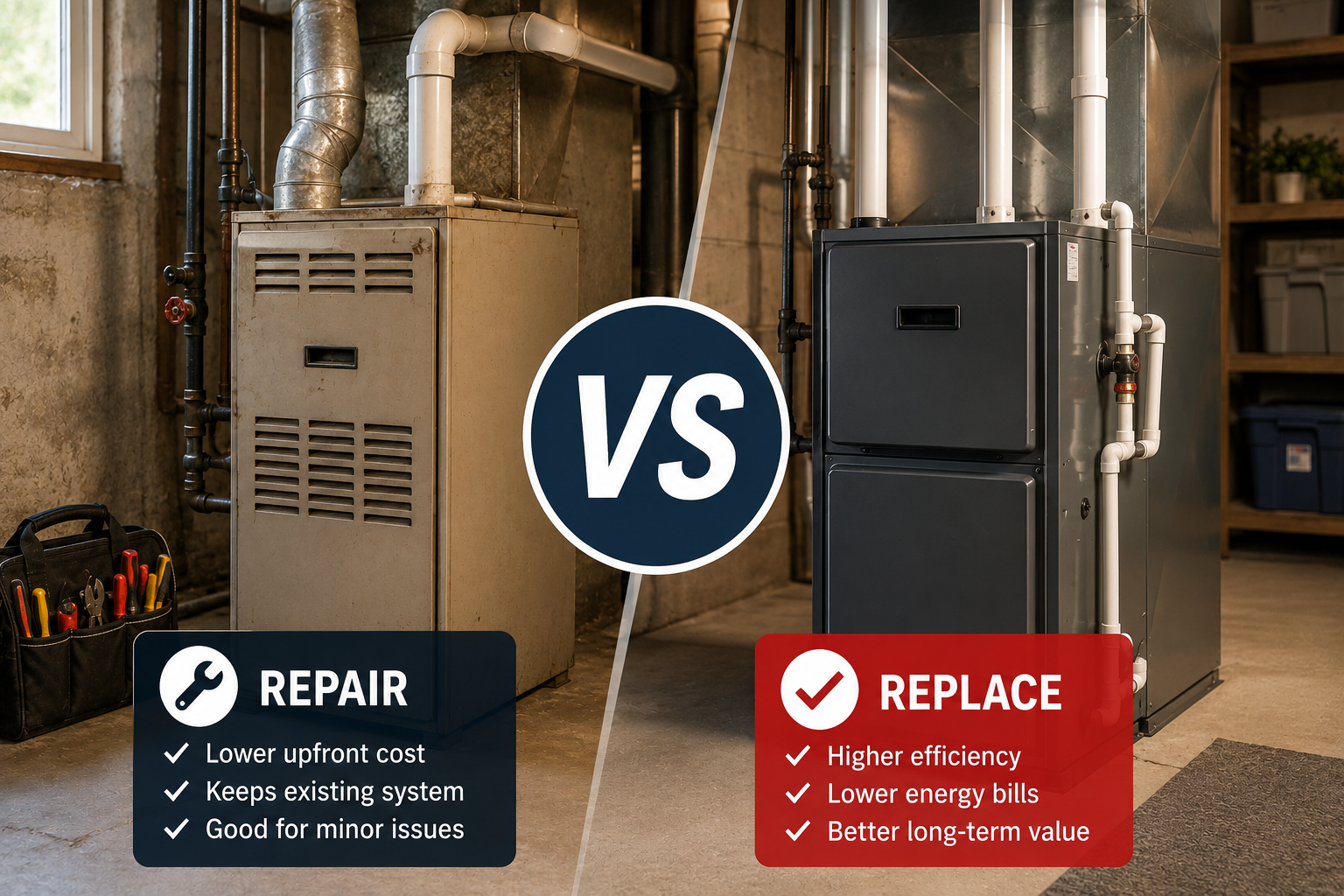
If your furnace is over 15 years old, breaking down frequently, struggling to heat the home evenly, or requiring expensive repairs, replacement may be the better long-term investment. If the issue is isolated and the system still has strong performance and efficiency, repair is often the smarter short-term option. The right decision depends on repair cost, furnace age, efficiency, and how reliably the system is heating the home.
Fast Decision Guide
If the furnace stopped working suddenly
A professional inspection can determine whether the issue is repairable or if major components are failing.
If you’re comparing cost vs. long-term value
Frequent repairs and rising energy bills often make replacement more cost-effective over time.
If the system is older
Most furnaces begin experiencing higher repair frequency and lower efficiency after 15–20 years.
Local Trust Snapshot
- Serving homeowners throughout Waukesha and nearby Milwaukee-area communities
- Licensed and insured HVAC technicians
- Same-day heating service available in many cases
- Residential furnace repair and installation expertise
- Financing options available for qualifying system replacements
How To Decide Between Furnace Repair or Replacement
A furnace problem does not automatically mean the entire system needs to be replaced. In many situations, a repair is still the most practical option.
The challenge is knowing when repairs stop making financial sense.
In colder climates like Wisconsin, heating systems work hard for long stretches during winter. Over time, wear and tear naturally increases, especially on older systems.
The decision usually comes down to four things:
- Furnace age
- Repair frequency
- Energy efficiency
- Cost of the repair itself
Consider the Age of the Furnace
Furnace lifespan plays a major role in deciding whether repair or replacement makes more sense.
Typical furnace lifespan
| Furnace Type | Average Lifespan |
|---|---|
| Standard gas furnace | 15–20 years |
| High-efficiency furnace | 15–20 years |
| Older legacy systems | Often less efficient after 15 years |
If the furnace is already approaching the end of its expected lifespan, investing heavily into repairs may only delay a future replacement.
Signs age may be becoming a problem
- Uneven heating
- Frequent breakdowns
- Rising utility costs
- Loud operation
- Difficulty maintaining temperature
Older systems also tend to become less efficient over time, even when repairs are completed.
Frequency of Repairs Matters
One repair does not necessarily justify replacing a furnace.
But repeated repairs within a short period often signal deeper system wear.
Common examples
- Ignition repairs
- Blower motor issues
- Thermostat failures
- Heat exchanger concerns
- Repeated airflow problems
If repair calls are becoming routine every heating season, replacement may reduce long-term costs and frustration.
The 50% Rule
A common HVAC guideline is the “50% Rule.”
What it means
If a repair costs more than 50% of the value of a new furnace system, replacement is usually the better long-term financial decision.
Example:
- Major repair: $3,500
- New furnace system: $6,000–$7,000
At that point, many homeowners choose to invest the money into a new system with updated efficiency, warranty coverage, and improved reliability.
Energy Efficiency Can Change the Math
Newer furnaces are significantly more energy efficient than many older systems still operating today.
That can impact:
- Monthly heating costs
- Indoor comfort
- System runtime
- Long-term operating expenses
Signs your current furnace may be inefficient
- High heating bills
- Furnace constantly running
- Hot and cold spots throughout the home
- Older single-stage equipment
- Poor airflow
In areas like Waukesha and the surrounding Milwaukee suburbs, heating costs during winter can become substantial if the system is inefficient.
When Furnace Repair Usually Makes Sense
Repair is often the better option when:
- The furnace is under 10–12 years old
- The issue is isolated
- Repair costs are manageable
- The system still heats efficiently
- Maintenance history is strong
Many furnace issues can be repaired successfully without replacing the entire system.
Learn more about Furnace Repair Services available throughout the Waukesha area.
When Furnace Replacement Is Usually the Better Option
Replacement is often recommended when:
- The furnace is 15–20+ years old
- Repair costs are high
- Breakdowns are becoming frequent
- Energy bills continue increasing
- Major components are failing
A new system may improve:
- Heating consistency
- Energy efficiency
- Indoor comfort
- Reliability during winter
Common Mistakes Homeowners Make
Waiting Until Complete Failure
Many homeowners delay replacement discussions until the furnace completely stops working during freezing weather.
This can limit options and increase emergency costs.
Focusing Only on the Immediate Repair Cost
A smaller repair bill may seem cheaper today, but repeated repairs can exceed replacement costs over time.
Ignoring Efficiency Loss
An aging furnace may still operate while quietly driving up utility bills every month.
Replacing Too Early
Not every older furnace needs immediate replacement. Some systems still have years of reliable service left with proper maintenance.
What Furnace Replacement Typically Includes
A professional furnace installation usually involves:
- Evaluating home size and heating demand
- Determining proper furnace sizing
- Removing the old system
- Installing the new furnace
- Testing airflow and system performance
- Verifying safe operation
Proper sizing and installation are critical for long-term performance and efficiency.
Explore Furnace Installation Services to learn more about replacement options.
Service Areas
1st Choice Heating & Cooling provides furnace repair and installation services throughout:
- Waukesha
- Muskego
- New Berlin
- West Allis
- Franklin
- Nearby Milwaukee-area communities
FAQ
How long should a furnace last?
Most residential furnaces last between 15–20 years depending on maintenance and usage.
Is it worth repairing an old furnace?
It depends on repair cost, efficiency, and how frequently the system has needed repairs.
What is the 50% Rule for HVAC?
If a repair costs more than 50% of the value of a replacement system, replacement is often recommended.
How do I know if my furnace is inefficient?
High utility bills, uneven heating, and constant runtime are common signs.
Should I replace my furnace before winter?
Replacing before peak winter demand can help avoid emergency breakdowns and scheduling delays.
Can frequent repairs increase long-term costs?
Yes. Multiple smaller repairs can eventually exceed replacement costs.
Do new furnaces lower energy bills?
Modern systems are generally much more energy efficient than older equipment.
How do professionals determine furnace size?
HVAC technicians use load calculations based on home size, insulation, airflow, and heating demand.
Is financing available for furnace replacement?
Many HVAC companies offer financing options for qualifying installations.
What’s the biggest mistake homeowners make?
Waiting until the furnace completely fails during winter weather.
Furnace Repair & Installation in Waukesha
Deciding between repair and replacement is easier when you understand the long-term cost, reliability, and efficiency of the system.
If your furnace is struggling to keep up, explore Heating Repair Services or learn more about Furnace Installation Services available throughout the Waukesha and Milwaukee area.
You can also view all Heating Services offered by 1st Choice Heating & Cooling.
Schedule a Furnace Evaluation
If you’re trying to decide whether to repair or replace your furnace, the simplest next step is having the system professionally evaluated.
Contact 1st Choice Heating & Cooling for furnace repair and installation services in Waukesha and surrounding communities.
