
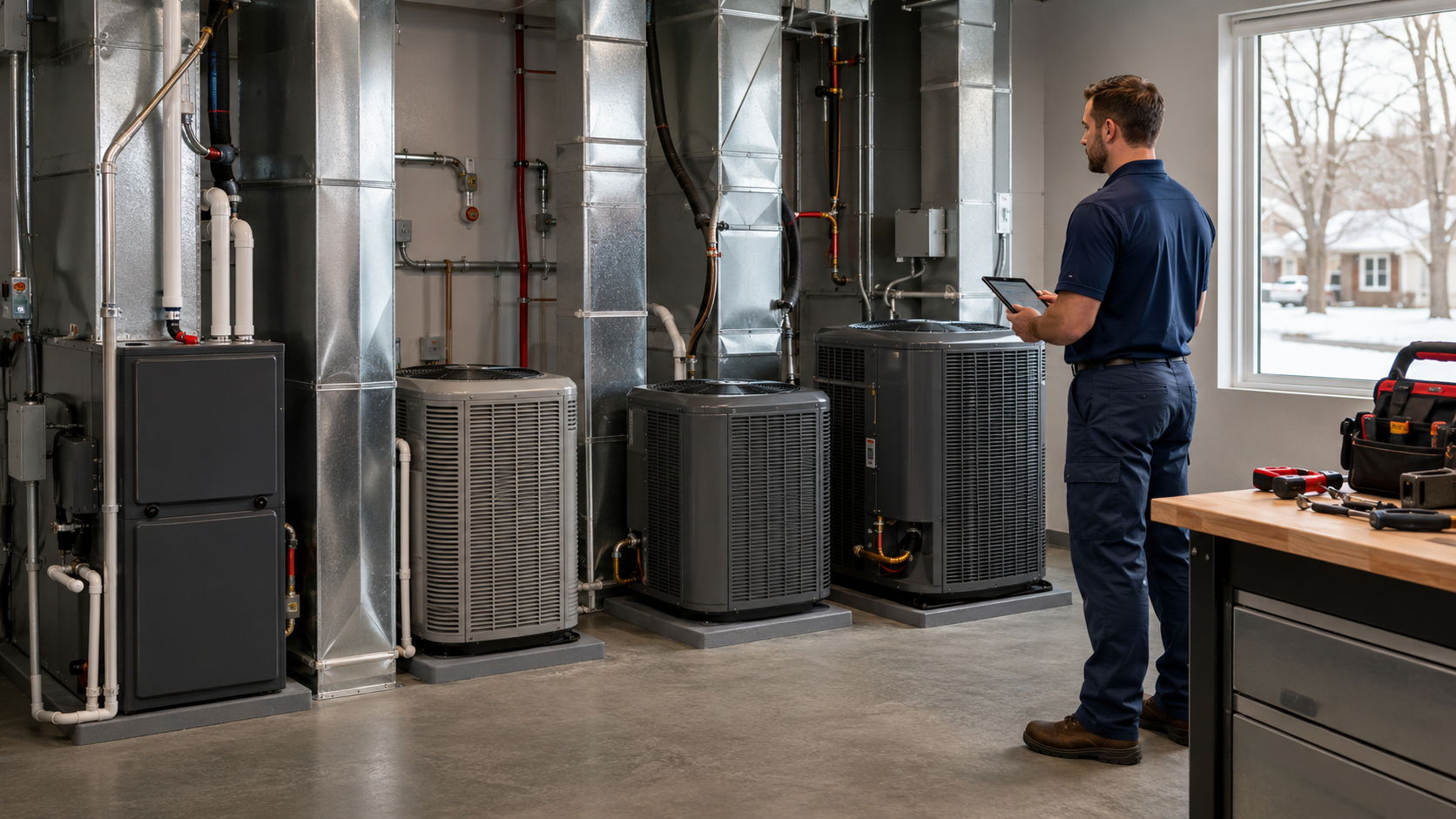
Choosing between single-stage, two-stage, and variable-speed HVAC equipment is not simply a choice between good, better, and best. The right system depends on the home, comfort goals, ductwork, budget, and how the equipment will be installed.
Quick Answer
Single-stage equipment usually has a lower initial cost and runs at one main output. Two-stage equipment adds a lower operating stage, while variable-speed or variable-capacity equipment adjusts more gradually. Advanced staging may improve temperature consistency, humidity management, and sound, but proper sizing and installation remain more important than buying the most complex system.
Fast Decision Guide
Focused on upfront cost?
Compare a properly sized single-stage system with the installed cost of staged alternatives.
Focused on comfort?
Ask how longer low-output cycles could affect temperature swings and summer humidity.
Replacing older equipment?
Confirm ductwork, electrical, thermostat, and equipment compatibility before choosing a system.
Why Homeowners Call 1st Choice Heating & Cooling
- Licensed and insured HVAC technicians
- Straightforward explanations before major repair or replacement decisions
- Residential heating, cooling, and indoor air quality expertise
- Serving Waukesha, Muskego, and nearby communities within the confirmed service area
- Financing options available for qualifying installations
What Is the Difference Between Single-Stage, Two-Stage, and Variable-Speed HVAC?
The terms describe how an HVAC system changes its output. A single-stage system generally operates at one full-output level. A two-stage system can run at a lower stage during milder conditions and move to a higher stage when demand increases. A variable-speed or variable-capacity system can adjust output across a wider operating range.
The technology affects more than equipment price. It can change temperature consistency, humidity control, sound, runtime, electrical requirements, compatible controls, and the way the system responds to the home.
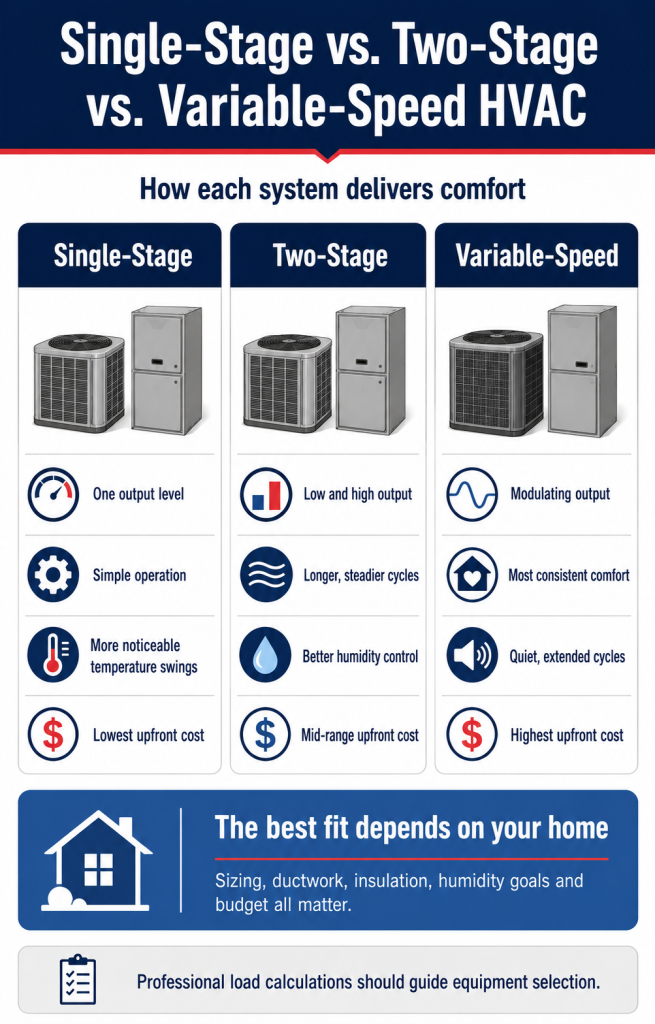
HVAC Staging Comparison
| System type | How it operates | Potential strength | Important tradeoff |
|---|---|---|---|
| Single-stage | Runs at one primary output level | Simpler equipment and a lower initial cost in many cases | Larger temperature swings and more noticeable cycling may occur |
| Two-stage | Uses a lower and higher operating stage | Longer low-stage runtimes can improve comfort | More components and controls than a single-stage system |
| Variable-speed | Adjusts output across a broad range | Steadier comfort, quieter operation, and stronger humidity management may be possible | Higher initial cost and greater dependence on proper setup and compatible controls |
How Staging Changes Comfort
A system does not need to run at full output every time the thermostat calls. During moderate weather, lower output can maintain temperature with longer, steadier cycles. That can reduce the hot-and-cold feeling created by short bursts of full-capacity operation.
Comfort still depends on correct sizing, ductwork, airflow, insulation, and installation quality. Advanced equipment cannot compensate for a system that is oversized or connected to restrictive ductwork.
Which Option Handles Wisconsin Humidity Best?
Longer cooling cycles generally give an air conditioner more time to remove moisture. Two-stage and variable-capacity equipment may run longer at lower output, which can help humidity control during warm, damp weather.
That does not make the most expensive option automatically correct. A properly sized single-stage system can still perform well. The decision should consider the home, existing ductwork, comfort complaints, budget, and how long the homeowner expects to keep the system.
Which HVAC System Is the Best Fit?
| Homeowner priority | Option worth comparing | Why |
|---|---|---|
| Lower initial equipment cost | Single-stage | A simpler configuration may meet the need when comfort is already consistent |
| Fewer temperature swings | Two-stage or variable-speed | Lower-output operation may maintain temperature more steadily |
| Humidity control | Two-stage or variable-capacity cooling | Longer cycles may remove more moisture |
| Quiet operation | Variable-speed | Gradual operation may reduce abrupt starts and full-speed runtime |
| Older or limited ductwork | Professional evaluation first | Duct capacity and static pressure can limit the right equipment choice |
Why Proper Sizing Matters More Than the Label
Oversized equipment may reach the thermostat setting quickly and shut off before it has run long enough to manage humidity. Undersized equipment may struggle during design temperatures. Before comparing stages, the contractor should evaluate the home’s heating and cooling load and inspect the duct system.
For cooling replacements, review how professional AC sizing works. For a complete installation discussion, visit the AC installation service page.
What to Compare in an HVAC Proposal
- Exact model numbers and matched indoor/outdoor equipment
- Heating and cooling capacity
- Efficiency ratings
- Thermostat and control requirements
- Ductwork or airflow changes
- Electrical scope
- Labor and warranty terms
- Commissioning and performance testing
Frequently Asked Questions
Is variable-speed HVAC worth the cost?
It may be worthwhile for homeowners who place a high value on consistent temperatures, humidity control, quieter operation, and long-term comfort. The value depends on the home and the installed price difference.
Does variable speed mean the fan runs all the time?
Not necessarily. Operating behavior depends on the equipment, thermostat, control settings, and system design.
Is a two-stage system more efficient than a single-stage system?
It may use energy more efficiently in some homes because it can operate at lower output during milder conditions. The actual result depends on sizing, installation, climate, and usage.
Can variable-speed equipment use existing ductwork?
Sometimes, but the duct system should be evaluated for airflow capacity, leakage, and static pressure before equipment is selected.
Which HVAC system is best for Wisconsin?
There is no universal best system. Wisconsin homes vary in size, insulation, ductwork, heating fuel, and comfort needs, so an in-home evaluation is the responsible starting point.
Compare HVAC Replacement Options
1st Choice Heating & Cooling can evaluate the home, existing equipment, ductwork, and comfort priorities before presenting appropriate replacement options.
